Category: Personal Injury

If you or a family member was seriously hurt, uncertainty about what comes next can add stress to an already difficult time. The Michigan personal injury lawsuit timeline is not the same in every case: medical recovery, evidence, insurance issues, and court schedules all matter. Knowing the usual stages can help you prepare without assuming that a claim will follow a fixed calendar.

Call 248-599-1607 to schedule a free consultation and discuss your next steps.

Schedule a free consultation

  • Get needed medical care and keep records of your treatment.
  • Preserve available evidence and report the incident through appropriate channels.
  • Do not assume an insurance negotiation pauses a legal deadline.

This article gives a general overview, not a prediction of how long a particular matter will take. Serious injuries, disputed responsibility, and multiple insurance policies can make the process more involved. A Michigan attorney can assess the facts and explain which deadlines and procedures may apply.

What are the main stages in a Michigan personal injury lawsuit timeline?

Many claims move through a sequence of investigation, medical evaluation, insurance discussions, and, when a lawsuit is filed, court procedures. These steps can overlap. Some matters resolve before a lawsuit; others require formal discovery or a trial. There is no reliable single duration that applies to every Michigan injury claim.

Stage What may happen Why timing varies
Care and initial documentation Medical evaluation, follow-up care, incident reporting, and record keeping Injury severity, treatment needs, and access to records
Investigation and claim review Collecting records, photographs, witness information, and insurance details Availability of evidence and whether responsibility is disputed
Demand and negotiations Presenting a claim and assessing any offer with supporting information Whether medical status and losses can be evaluated, and insurer response
Lawsuit and discovery Filing pleadings, exchanging information, and taking depositions Court schedule, number of parties, and complexity of the evidence
Resolution or trial Settlement discussions, mediation, pretrial steps, or a trial Disputed issues, settlement progress, and available court dates

These stages do not always form a straight line. For example, a claim investigation may start while treatment continues, and an insurer may ask for information in several rounds. A lawsuit may be filed while some medical questions remain unresolved, depending on the case and applicable deadlines. If new evidence appears, the parties may need to revisit an earlier assessment. It can help to think in terms of milestones—such as obtaining key records or completing a medical evaluation—rather than counting down to a fixed finish date.

The table is a planning overview, not a promise about duration or outcome. A case may pause while a key issue is clarified, and negotiations can happen at several points. People facing a catastrophic injury may also need a longer view of future care and support. A Michigan life care plan can be relevant when future medical and support needs must be considered.

What should you do while recovering from an injury?

Your health comes first. Follow the treatment plan provided by your medical professionals and tell them about symptoms or changes. Consistent documentation can help create a clearer record of the injury and its effect on daily life. Do not delay care simply because you are unsure how insurance will handle a bill.

When you are able, keep useful information in one place. It may include:

  • Medical visit summaries, bills, prescriptions, and instructions for follow-up care.
  • Photographs of injuries, property damage, and the location, if they are available.
  • Names and contact details for witnesses, along with incident or police report information.
  • Messages from insurers and copies of forms, letters, or claim numbers.
  • A short, dated record of missed work, care needs, and daily activities affected by the injury.

A simple dated log can make a large folder of records easier to understand. Note when a symptom changes, a follow-up visit occurs, or a daily task becomes difficult. Keep the notes factual and brief; this is a memory aid, not a substitute for medical records or professional advice. If you miss work or someone else takes on household or caregiving duties, record the dates and what changed. Preserve receipts and communications that relate to those changes. These details can help explain the practical effects of an injury when a claim is reviewed later.

Keep original files when possible and avoid editing photographs or documents. Store copies securely. If a family member is handling paperwork because you cannot, make a note of who received or sent each item. When a crash is involved, the insurance questions can be different from a claim against another party. The firm’s overview of Michigan PIP coverage provides background on one part of that system.
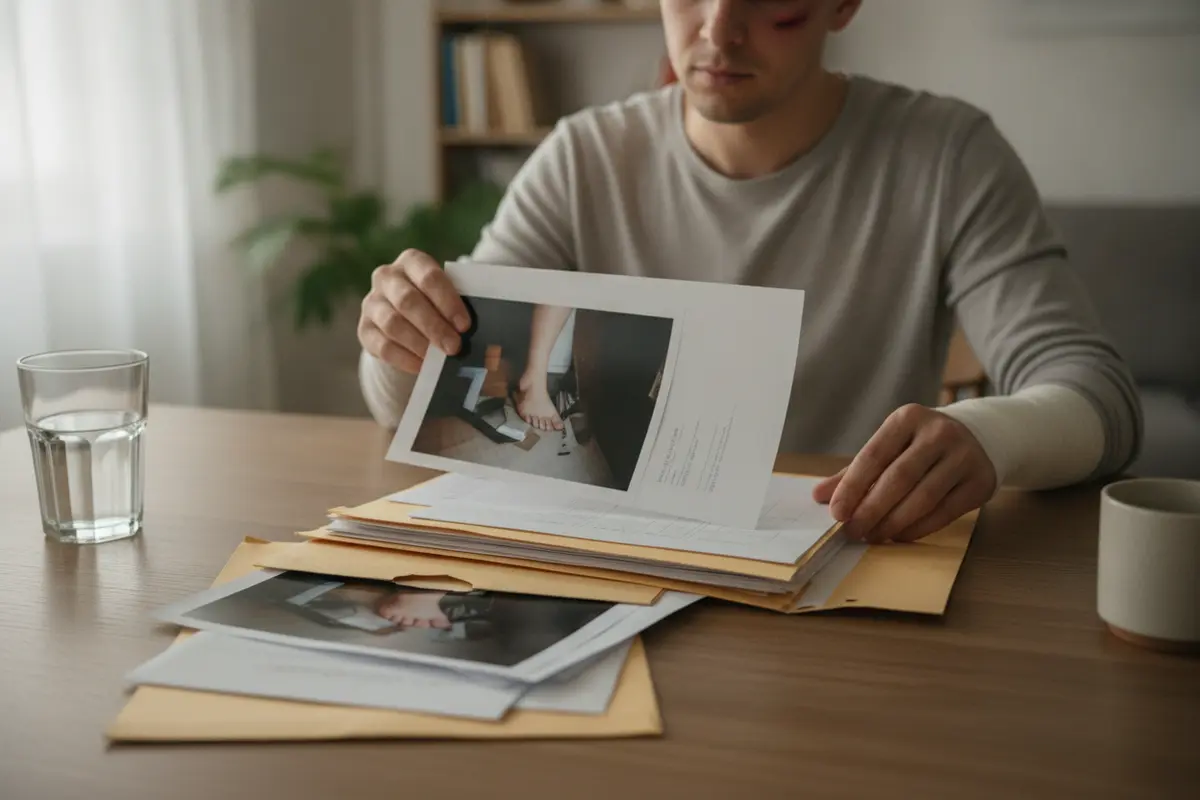
An injured person organizing medical papers, incident photographs, and insurance letters in a folder

Be cautious about signing a broad release or giving a recorded statement before you understand what is being requested. This is not a direction to ignore an insurer or a valid request. It is a reminder to read documents carefully and ask for help if the scope or consequences are unclear. For an overview of the firm’s work with injury matters, visit its Michigan personal injury practice areas.

How does a claim investigation affect the schedule?

An investigation develops the factual record. Depending on the incident, that may involve reviewing photographs, witness accounts, reports, medical records, insurance policies, and other documents. Some evidence can become harder to obtain over time. Promptly preserving what you already have may help, even when you are still focused on treatment.

Responsibility may be straightforward in one matter and contested in another. A disagreement about how an accident happened, the extent of an injury, or the connection between the event and later symptoms can lead to more investigation. If multiple parties or insurers are involved, identifying the relevant coverage may add steps.

For instance, if two accounts of a collision differ, the parties may need to compare photographs, vehicle damage, witness descriptions, and available reports before they can evaluate responsibility. If an injury was not apparent immediately, medical records from different dates may be reviewed to understand what symptoms were reported and when. These are examples of why a request for more information does not necessarily mean that a case has stalled; it may show that a factual question needs a clearer answer. Keep copies of what you submit and note the date and recipient so that you can track outstanding requests.

Auto cases have their own legal framework. Michigan law addresses when an injured person may pursue certain tort damages after a motor vehicle accident, including statutory conditions and comparative-fault rules. The text of MCL 500.3135 is one source for those rules. The law’s application depends on the facts and current legal requirements, so a general article cannot determine whether a particular claim qualifies.

For a crash claim, questions about no-fault benefits and a claim against another driver should not be treated as identical. PIP medical coverage, work loss or replacement services, and Property Protection Insurance are separate coverages. Learn more about the firm’s work on Michigan car accident claims if that is the type of matter you are handling.

When does a lawsuit begin, and what happens after filing?

A lawsuit begins when a complaint is filed in court, but filing is not the first step in every injury matter. A lawyer may investigate and communicate with insurers before deciding whether litigation is appropriate. Whether to file, and when, requires attention to the applicable deadline and the goals and facts of the case.

Once a case is filed and the defendant is served, the parties follow court rules and scheduling orders. The defendant may respond to the complaint. The court may set dates for exchanging information, motions, settlement discussions, and other proceedings. The schedule is case-specific and can change as the court addresses requests or the parties complete required work.

During discovery, each side may seek relevant information from the other. That can include written questions, document requests, and depositions, which are sworn interviews. In a serious injury case, the parties may review medical history, treatment, work impact, and expert opinions. Discovery helps each side understand what evidence supports or challenges the claims. It is not unusual for settlement conversations to continue while litigation is underway.

Discovery can feel more manageable when you understand the different kinds of requests. Written questions ask for information in a structured format; document requests may seek records that relate to disputed issues; a deposition allows attorneys to ask questions under oath. A person who receives a request should not guess at the response or assume every document in a personal file is relevant. The appropriate scope depends on the case and the court rules. An attorney can explain what is being requested, how to gather responsive materials, and what to do if a request is unclear.

Before meaningful settlement discussions, the parties may need enough information to evaluate liability, the injury, and its effects. For example, missing treatment records or unanswered questions about future care can make it harder to assess a proposal. In a case with lasting limitations, the injured person and legal team may need to understand how those limitations affect work, household responsibilities, and daily activities. The information needed will depend on the claim; there is no checklist that fits every case.

If the parties reach an agreement, the final paperwork matters. A written release may resolve some or all claims, and the terms should be understood before signing. Resolution can also involve processing documents and arranging payment, so an agreement in principle is not always the same as funds being available immediately. Ask what remains to be completed and which claims the proposed release covers.

When a death results from an injury, the legal process may involve different parties and issues. Families can review the firm’s information about wrongful death claims in Michigan to understand the subject at a general level.

What deadlines can affect the Michigan personal injury lawsuit timeline?

Legal deadlines are not the same as an estimate of how long a case will take. Michigan’s limitation statutes set time limits for bringing different kinds of actions, and the applicable rule can depend on the claim and circumstances. The Legislature’s text of MCL 600.5805 addresses limitation periods for injuries to people and property. Do not rely on a general summary to calculate your own filing date.

Some matters may involve notice requirements, special parties, insurance claim rules, or facts that affect how a deadline is measured. The date of an incident alone may not answer every question. Also, contacting an insurer or negotiating a settlement does not necessarily extend a court filing deadline. If you are unsure, seek case-specific legal guidance promptly.

At the same time, avoid rushing into a settlement simply to make the process end. A settlement may require a release of claims. Before agreeing, understand what claims are being resolved and whether the known information is enough to assess the effects of the injury. An attorney can explain considerations without guaranteeing an outcome.

Why might a case take longer than expected?

Several practical factors can affect timing. Treatment may still be underway, and the lasting effects of an injury may not yet be clear. In other cases, records are incomplete, parties disagree about responsibility, or a claim involves several insurers. Each added factual or legal issue can require more work before a decision can be made.

Compare two general situations. If the records are available, the key facts are not seriously disputed, and the injury is well understood, the parties may be able to assess a claim with fewer open questions. If the injured person is still receiving care, witnesses disagree, or several parties have different accounts, additional evaluation may be needed. Neither pattern guarantees a particular schedule or outcome. The comparison simply shows why the same calendar estimate cannot fit every case.

Court proceedings add another layer. The availability of a hearing or trial date depends on the court’s calendar. Motions, discovery disputes, expert evaluations, and efforts to resolve the case can also affect the schedule. These are ordinary parts of litigation, not proof by themselves that a claim is going well or poorly.

Some claims resolve through negotiations without a trial. Others proceed further because the parties disagree about liability or damages. A lawyer can explain the tradeoffs of a proposal in light of the available evidence and the client’s needs. No timeline can guarantee a settlement or a particular result.

How can you prepare for a first legal consultation?

You do not need to assemble a perfect file before asking questions. Bring or make a list of what is available, and be ready to explain what happened in your own words. Helpful items may include:

  • The date and location of the incident and a brief description of what occurred.
  • Names of involved people, witnesses, businesses, or responding agencies.
  • Information about medical care, current symptoms, and future appointments.
  • Insurance information and any letters, forms, or calls from a claims representative.
  • Questions about deadlines, expenses, work disruption, or who may have a claim.

It is fine to say that you do not know an answer or do not have a particular document. An attorney can identify what additional information may be useful. At Atnip & Associates, the stated approach is personalized advocacy for people facing serious injury and loss. Learn about the firm’s background on its attorneys and firm page. The firm represents people throughout Michigan; its Michigan areas served page gives additional geographic information.

A consultation is also an opportunity to understand the fee arrangement. The firm describes its contingency fee arrangement as no fee unless it wins. Ask questions about how fees and case expenses are handled in your situation before deciding how to proceed.

Contact Atnip & Associates to discuss your situation

Frequently Asked Questions

How long does a Michigan personal injury lawsuit take?

There is no universal timeline. Some claims resolve before a lawsuit, while cases involving serious injuries, disputed facts, or extensive discovery may take longer. Court scheduling and the information needed to evaluate the claim also matter.

Does an insurance claim mean a lawsuit has been filed?

No. An insurance claim and a court lawsuit are different processes. A claim may be investigated or negotiated without a lawsuit being filed. A lawyer can explain what stage applies to your matter and what deadlines to consider.

Can I wait until treatment is finished before asking a lawyer about deadlines?

Do not assume that waiting is safe. The deadline depends on the claim and facts, and treatment or insurance discussions do not automatically answer when a case must be filed. Get advice early if you have a question about a deadline.

Will every personal injury lawsuit go to trial?

No. Some cases resolve through negotiations or another form of resolution. If the parties cannot reach an agreement, a case may continue through court proceedings and potentially to trial. The path depends on the facts and decisions made during the case.

Talk with a Michigan personal injury attorney

Understanding the stages can make the process feel less uncertain, but your circumstances determine which rules and steps apply. For others, it may be just another case; for you and your family, it is personal. Atnip & Associates can review the information you have and discuss possible next steps without promising a particular result.


After a serious injury, it is natural to want a clear answer about what your claim may be worth. But settlement decisions should reflect the actual harm you experienced, the evidence supporting responsibility. And the losses you may continue to face, not a number borrowed from someone else’s case.

There is no universal formula for personal injury settlement amounts in Michigan. An evaluation may consider the severity and permanence of the injury, medical treatment and future care. Lost income, effects on daily life, available insurance coverage, and the evidence concerning fault. A careful review is necessary before making decisions about a claim.

Call 248-599-1607 to schedule a free consultation about your injury claim.

The analysis begins with the specific facts of your injury and the losses it caused. Understanding how those factors fit together can help you approach the process with realistic expectations and better questions for an attorney.

What goes into personal injury settlement amounts in Michigan?

There is no honest formula that can assign the same value to every Michigan injury claim. A case-by-case evaluation considers what happened, who may be legally responsible, the nature of the injuries. And how those injuries affect the person’s health, work, relationships, and daily life. The available insurance or other sources of compensation also matter. These factors must be examined together rather than reduced to a percentage or a guaranteed outcome.

Economic harm is the part of a claim that can often be documented through records. Depending on the circumstances, it may include reasonable medical expenses, rehabilitation, prescription costs, time away from work, and a diminished ability to earn income. In some cases, evaluating future needs requires careful review of medical opinions and the likely effects of an injury over time. A personal injury lawyer can help organize this information and identify gaps that may make a claim harder to evaluate.

Noneconomic harm is different. It addresses effects that do not come with a simple invoice, such as pain, emotional distress, loss of enjoyment of life, physical limitations, and changes to family relationships. The significance of these effects depends on the person’s experience and the evidence supporting it. A serious injury that changes ordinary activities may require a different analysis than an injury that resolves quickly. But no responsible attorney should promise a particular result from that distinction.

Liability and comparative fault can also affect the analysis. Under Michigan’s comparative-fault statute, an injured person’s assigned fault may reduce damages, with additional statutory rules that can apply when the person’s fault exceeds the combined fault of others. In a case involving multiple parties, Michigan law addresses allocation of fault and damages in qualifying actions. The facts, available evidence, and legal claims should be reviewed before drawing conclusions about how those rules apply.

Finally, a settlement is not just a payment. The proposed release, liens, case costs, coverage, and the person’s remaining medical and financial needs can affect the practical value of an offer. For broader guidance, see Atnip & Associates’ personal injury lawyer resource. A confidential case review can help an injured person understand which facts and documents deserve attention before making an important decision.

How does injury severity affect a claim?

Injury severity is evaluated through more than a diagnosis or a single medical bill. A claim review considers how the injury affects the person’s health, function, independence, work, relationships, and need for care over time. A serious diagnosis may support a substantial claim, but the evidence must show the injury’s actual effects and the connection between the injury and the responsible party’s conduct.

Diagnosis, treatment, and prognosis

Medical records help establish what happened, when symptoms began, and how healthcare professionals diagnosed and treated the condition. The course of treatment may include emergency care, surgery, hospitalization, medication, physical therapy, occupational therapy, or other services. Treatment history alone does not determine an outcome. It is considered alongside the diagnosis, the patient’s response to treatment, and the medical prognosis.

Prognosis addresses what doctors reasonably expect in the future. Some injuries improve with time and treatment. Others may result in ongoing pain, restrictions, additional procedures, or permanent impairment. When future care is relevant, the analysis may require carefully supported medical opinions about expected treatment rather than speculation. A related guide to catastrophic injury rehabilitation claims explains why rehabilitation needs and functional recovery can require detailed evaluation.

Impairment, permanence, and daily life

Severity also includes what the person can no longer do, or can do only with difficulty. Evidence may address mobility, lifting, concentration, sleep, personal care, household tasks, driving, recreation, and the ability to participate in family or community life. A temporary restriction and a permanent loss of function present different questions, so the duration and medical support for an impairment matter.

Family observations, work records, therapy notes, and consistent medical documentation can help describe these effects. The focus should be an accurate account of the person’s experience, not an attempt to exaggerate symptoms or predict a result.

Future care and long-term needs

Some injuries require continuing treatment, equipment, medication, assistance, or rehabilitation. Future needs should be evaluated before a claim is resolved because a release may affect the ability to pursue related damages later. Atnip’s resource on long-term medical treatment in Michigan injury claims provides related information without replacing individualized legal and medical review.

How do medical needs and lost income change the analysis?

Medical records and employment records help show how an injury affects both your present circumstances and your future. A diagnosis alone may not capture the treatment required, the limitations that remain, or the practical support a person needs while recovering. Records should be organized across providers, including evaluations, imaging, prescriptions, therapy notes, work restrictions, and documented changes in symptoms.

Future care requires careful attention. A treating professional may identify continuing therapy, rehabilitation, equipment, medication, or additional procedures. The analysis should account for whether those needs are reasonably supported by the medical evidence and how they may affect daily activities. Our guide to long-term medical treatment and Michigan injury claims provides related information, while more serious injuries may require a broader catastrophic injury rehabilitation evaluation.

Attorney reviewing medical and employment records with an injured client

How does lost income affect the evaluation?

Work-related losses can include time missed during treatment, reduced hours, changes in duties, and an inability to return to the same work. Evidence may include payroll records, tax documents, employer statements, attendance records, job descriptions, and written restrictions from medical providers. If an injury affects future earning capacity, the analysis may also consider education, experience, transferable skills, physical limitations, and the type of work reasonably available.

Some injuries also make ordinary household tasks difficult. Replacement services, such as help with personal care, transportation, child care, or household responsibilities, should be documented rather than assumed. A recovery journal can connect medical limitations to those changes without exaggerating them.

What reduces the amount ultimately recovered?

The headline value of a claim is not necessarily the amount a person takes home. Medical expenses, case costs, insurance reimbursement claims, and liens may affect the net recovery. Those issues should be identified and addressed before signing a release. For broader guidance about evaluating a Michigan personal injury claim, speak with a lawyer who can review the records and the specific facts rather than relying on generic personal injury settlement amounts.

How can fault and insurance coverage affect compensation?

Liability and available insurance coverage can shape how an injury claim is evaluated, but neither issue can be reduced to a simple formula. The analysis may involve what each person did, the strength of the evidence, the type of claim, and which policies or statutory benefits may apply. Michigan law also treats some benefits differently from damages pursued in a personal injury lawsuit.

How does comparative fault apply in Michigan?

Michigan’s comparative-fault rules can reduce damages when the injured person is found partly responsible. Under MCL 600.2959, damages in a personal-injury action are reduced by the injured person’s percentage of fault. The statute also addresses circumstances in which the person’s fault is greater than the aggregate fault of others, including different treatment of economic and noneconomic damages. The result depends on the facts and the legal claims involved, so a general rule should not be treated as a prediction for a particular case.

In qualifying actions involving multiple parties, MCL 600.6304 directs the factfinder to determine total damages and percentages of fault, including relevant nonparties, subject to statutory provisions and exceptions. Evidence such as photographs, incident reports, medical records, witness accounts, and testimony may affect how responsibility is evaluated. For additional background, see the firm’s Michigan comparative-fault resource, while keeping in mind that a car-accident article may not address every type of personal injury claim.

Why does insurance coverage matter?

Even when another party may be legally responsible, the available coverage can affect the practical path toward recovery. A careful review may identify the responsible party, applicable liability policies, additional insured parties, and exclusions or limits that require attention. These details should be confirmed from the policy and claim documents rather than assumed from an insurer’s initial position.

Car-accident claims also require a clear distinction between Michigan no-fault benefits and a tort claim. PIP medical coverage, work-loss benefits, replacement services, and Property Protection Insurance are separate coverage categories, not one combined settlement benefit. The firm’s Michigan no-fault lawyer resource provides related information. Whether insurance proceeds can address the full impact of an injury may depend on medical needs. Lost income, fault, coverage, and the evidence supporting each part of the claim.

What evidence helps evaluate a Michigan injury claim?

Useful evidence helps an attorney understand what happened, how the injury affected your life, and which losses may need further evaluation. It can inform a discussion about personal injury settlement amounts, but it cannot guarantee a result or establish a universal value. Preserve what you can while following your medical providers’ advice and seeking prompt care for your injuries.

  1. Medical records and treatment information. Keep records of diagnoses, imaging, prescriptions, referrals, therapy, procedures, and restrictions. Follow the treatment plan provided by your clinicians. A consistent medical record can help connect the injury to the event and show how symptoms and care needs developed over time. If future treatment may be necessary, ask your providers what follow-up or evaluation they recommend rather than trying to predict it yourself.
  2. Wage and work-loss proof. Save pay stubs, tax records, employment schedules, disability paperwork, and written information from your employer about missed work or restrictions. If an injury affects your ability to perform your usual duties or earn income in the future, that issue may require additional documentation and professional evaluation. Do not assume that one document will establish every aspect of an income-related claim.
  3. Scene and other physical evidence. Preserve photographs or video of the scene, visible injuries, property damage, hazardous conditions, and anything else that may help explain what occurred. Keep relevant items in their current condition when reasonably possible. Record the date, location, and source of each file so its context is not lost.
  4. Witness information. Write down the names and contact information of people who saw the event or observed your condition afterward. Briefly note what each person personally observed, without asking anyone to guess, exaggerate, or adopt a particular version of events.
  5. Insurer and other communications. Keep letters, emails, text messages, claim numbers, recorded-statement requests, and settlement documents. Avoid making assumptions or signing a release before you understand what it covers. A focused review of a proposed offer should account for its terms and the claims it may release, not only the immediate payment.
  6. A recovery journal. Make dated notes about pain, symptoms, sleep, mobility, appointments, missed activities, household tasks, and help you need from others. Keep the entries accurate and private. This record can help you describe day-to-day effects that may not appear fully in a medical chart.

Evidence is most useful when it is organized and truthful. A Michigan personal injury lawyer can review the available information, identify gaps, and explain which questions require more investigation. For general information about requesting guidance on a specific issue, visit the Atnip & Associates contact page.

How should you review a settlement offer?

A settlement offer should be evaluated against the full impact of the injury, not simply the speed of payment. An insurer’s proposal may resolve some disputed issues, but accepting it usually requires signing a release that can affect future claims. Before responding, review what the offer covers, what it excludes, and whether the available evidence supports the proposed resolution.

Questions to ask when reviewing a personal injury settlement offer
Issue to review Questions to consider
Immediate payment What losses and expenses does the proposed payment address now? Are medical treatment, lost income, property damage, or other documented harms included?
Future needs Has the evaluation considered ongoing treatment, rehabilitation, medication, equipment, impairment, or changes to work and daily life? A claim may not be fully understood while the medical outlook remains uncertain.
Disputed liability What facts does the insurer rely on when assigning responsibility? Review witness statements, records, photographs, reports, and any comparative-fault argument before accepting an adjustment to the claim.
Release language Which people, companies, insurers, and claims would be released? Does the document waive rights connected to injuries or losses that are not yet known?
Net recovery What remains after case expenses, medical liens, reimbursement claims, or other obligations are addressed? The stated offer and the amount ultimately retained may be different.
Professional review Has an attorney reviewed the evidence, the proposed release, and the consequences of signing before you respond? Consider the firm’s guide to reviewing Michigan settlement offers for related considerations.

There is no universal formula for deciding whether an offer is adequate. The right review depends on the injury, available coverage, liability evidence, treatment outlook, and the terms of the release. A lawyer can help identify unresolved issues and explain the consequences of accepting or declining a proposal. The FAQ below addresses common questions about evaluating personal injury settlement amounts.

Frequently Asked Questions

Can anyone tell me exactly what my claim is worth?

No honest evaluation can promise an exact figure before the facts are developed. The analysis may consider the nature and permanence of the injury, medical needs, lost income, effects on daily life, available insurance, and disputed liability. A case-specific review can identify the evidence needed to assess potential compensation without relying on settlement ranges or guarantees.

Does Michigan fault affect a personal injury settlement?

It can. Michigan law provides that damages in a personal-injury action are reduced by the injured person’s percentage of comparative fault, subject to the rules and exceptions in the statute. MCL 600.2959 also addresses situations in which the injured person’s fault is greater than the aggregate fault of others. So the effect should be reviewed based on the facts of the claim.

Do future medical expenses matter in the evaluation?

Yes. A serious injury may require ongoing treatment, rehabilitation, medication, equipment, or additional procedures, and those needs can affect the analysis. Medical records and qualified opinions about prognosis and future care help show how an injury may continue to affect health, work, and daily activities.

Should I accept an insurer’s first offer?

Do not assume that an initial offer reflects the full impact of an injury. Before signing, review the proposed release, disputed liability, future needs, liens or other costs, and the amount you would actually receive after case-related obligations. Because accepting an offer may affect your ability to pursue additional compensation, consider obtaining case-specific legal guidance first.

Schedule a Free Consultation About Your Michigan Injury Claim

Because settlement evaluations depend on the facts, a case-specific review can help you understand the issues that may affect your claim and possible next steps. Call 248-599-1607 to schedule a free consultation with Atnip & Associates, PLLC. The firm can listen to your concerns, discuss the available information, and explain whether further evaluation may be appropriate for your Michigan personal injury claim.

A sudden injury, unexplained fear, or sharp change in an older adult’s condition can leave a family unsure what to do first. You do not need to prove abuse before raising a concern, but it helps to act promptly. Focus on the resident’s immediate safety, and share what you observed with the appropriate authority.

Call 248-599-1607 to schedule a free consultation.

For families looking up “state of Michigan report nursing home abuse,” start by contacting the public agency that fits the concern. Use emergency services if someone is in immediate danger. Report other care concerns to the state agency responsible for facility oversight or adult protection.

  • Call 911 if the resident faces immediate danger or needs urgent medical care.
  • For non-emergency concerns, make a clear report to the appropriate state agency.
  • Write down dates, observations, and steps taken so you can explain the concern accurately.

Different concerns may call for different reporting channels. Understanding who handles each kind of report can help you take the next step without delaying attention to the resident.

Where Can You Report Nursing Home Abuse in Michigan?

If a resident may be in immediate danger or needs urgent medical care, call 911 or seek emergency care first. For a concern about care at a nursing home, Michigan families can contact the state agency that oversees facility care. If the concern involves abuse, neglect, or exploitation of a vulnerable adult, they can also report it to Adult Protective Services (APS). These are distinct routes, and the right next step depends on the situation. A state of Michigan report nursing home abuse guide can help families identify which agency to contact.

Concern Starting point
Immediate danger or urgent medical need Call 911 for emergency response and urgent care.
Care or services at a covered nursing home Contact LARA’s Bureau of Survey and Certification.
Suspected abuse, neglect, or exploitation of a vulnerable adult Contact Michigan Adult Protective Services.
  • Immediate danger or urgent medical need: Call 911. Do not wait for an administrative complaint process when a resident needs immediate help.
  • Care or services at a nursing home: Contact the Michigan Department of Licensing and Regulatory Affairs (LARA), Bureau of Survey and Certification (BSC). BSC accepts concerns involving nursing homes and other covered health facilities. This includes suspected abuse, neglect, poor care, unsafe conditions, staffing problems affecting care, and resident rights. Use the official BSC complaint information or call 1-800-882-6006. Michigan law identifies this toll-free complaint line. The BSC online complaint form is another reporting option.
  • Suspected abuse, neglect, or exploitation of a vulnerable adult: Call Michigan APS at 1-855-444-3911. The MDHHS Adult Abuse and Neglect page says reports can be made any time, day or night. APS focuses on the vulnerable adult, while BSC reviews concerns about care and services provided by covered facilities.

A single incident may raise both a resident-safety concern and a facility-care concern. Families may need to contact both agencies. APS reporting does not replace a BSC complaint about nursing home care, and BSC does not replace emergency services. MDHHS says APS staff investigate allegations within 24 hours after a report is received. That is a response timeframe, not a promise about findings or resolution. Michigan law requires a toll-free nursing home complaint line that is accessible 24 hours a day. A response must start within 24 hours for complaints identified as priority. Ask LARA how it classifies a report; not every complaint is necessarily a priority.

BSC handles complaints about state-licensed or federally certified nursing homes and other covered providers. It does not handle every long-term-care setting or every kind of dispute. For example, its complaint page directs concerns about adult foster care or assisted living elsewhere, and billing or insurance complaints are handled through another route. If you are unsure which agency applies, use the official pages above to confirm the appropriate reporting channel. Neither route should be treated as a guarantee of a particular investigation finding or outcome.

When you report, describe what you observed or were told as clearly as you can, and identify the resident and facility if known. You do not need to decide on your own whether the conduct meets a legal definition before raising a concern. The family can also read the firm’s guide to Michigan nursing home abuse legal options.

How Do You File a Complaint with Michigan LARA?

For concerns about care or services in a licensed or federally certified nursing home. You can submit information to the Michigan Department of Licensing and Regulatory Affairs (LARA), Bureau of Survey and Certification (BSC). BSC reviews concerns about suspected abuse or neglect, mistreatment, poor care, unsafe conditions, staffing impacts on care, and resident rights. A report is not a finding about what happened.

You can use the BSC online complaint intake form. LARA also lists a phone option at 800-882-6006. Review the current BSC complaint instructions for the available reporting routes and facility types before submitting.

Before you begin, collect what you can from the form’s requested details. You do not need to fill gaps by guessing. Useful information includes:

  • The facility’s name, street address, city, and facility type.
  • The incident date and year, approximate time of day, and location within the facility, such as a floor, room, or dining area.
  • A clear description of the concern, including what you observed or learned and any relevant details about the resident.
  • Your name and contact details, plus your preferred way for BSC to contact you.

Use specific, factual language. Separate what you saw from what others told you. Mark any uncertain dates or details as estimates. The intake form requests reporter and contact information. Michigan law also contemplates anonymous complaints and generally restricts disclosure of names, subject to exceptions. These include consent, a hearing or court case, or disclosure deemed essential to the investigation. If disclosure is essential, the statute gives the complainant a chance to withdraw before it occurs. This is not an absolute promise of anonymity. Ask LARA about current privacy options if you are concerned.

LARA says the BSC receipt notice is sent within 7-10 business days. This confirms receipt, not a finding. It is not a promise about review time or results. Keep your submission and confirmation. The complaint line is open 24 hours a day. For a complaint classified as priority, the state must start a response within 24 hours. Not every complaint is priority, and an investigation may take longer. Call 911 in an emergency.

Some issues fall outside BSC’s scope. These include billing or insurance matters, complaints about a health professional’s license, and complaints involving adult foster care or assisted living facilities. For those concerns, follow the agency or complaint process listed in LARA’s instructions.

What Should You Do First to Protect the Resident?

If the resident may be in immediate danger, focus on getting help and moving them to safety if you can do so without creating another risk. A suspected abuse or neglect report matters, but completing paperwork should not delay urgent medical care. If there is a medical emergency or an immediate threat, call 911 or seek emergency help first. A state complaint, a call to an attorney, or a conversation with facility leadership is not a substitute for emergency response.

When the immediate danger has passed, speak calmly with the resident in a private, comfortable setting if possible. Listen without pressing them to repeat details or suggesting what they should say. Ask what they need right now, and whether they feel safe where they are. If they cannot communicate easily, note what you observe and share health concerns with an appropriate medical professional. Avoid confronting a person you suspect may be involved if that could increase risk to the resident.

Simple Steps for Preserving What You Observe

  1. Get immediate medical help or contact 911 if needed.
  2. Write a dated, factual note of what you saw or heard.
  3. Keep relevant messages and records intact.
  4. Report the concern to the appropriate agency.

Social worker listening to an older resident and family member

As you arrange care and consider reporting, keep a straightforward record of what you personally observed and what the resident told you. These notes can help you explain the concern accurately to the appropriate agency or care professional. They are a practical aid, not a special legal requirement. A simple checklist may include:

  • The date, approximate time, and place of each event or observation.
  • What you saw or heard, using the resident’s own words when you can remember them, and separating those words from your interpretation.
  • Any visible injury, change in condition, or unmet need, along with steps taken to obtain care.
  • The names or descriptions of people present and anyone else who may have witnessed the event.
  • Relevant messages, care-related paperwork, or photographs that can help explain the concern, if taking or keeping them is appropriate and lawful.

Keep original messages and records intact. Note when and how you received them. Do not alter facility records, access accounts without permission, or photograph other residents or private information. If you are unsure whether an image is appropriate, leave it out and describe what you observed. Record who you speak with, when you contacted them, and any next step they described. If the resident’s condition changes or a new urgent risk appears, seek medical or emergency help rather than wait for an administrative review.

Once urgent needs are addressed, you can make a separate report to the appropriate agency and seek guidance about longer-term options. Keep those steps distinct: documentation may help communicate what happened, but only the relevant authorities can assess a complaint, and a lawyer’s review does not replace emergency care.

How Can a Long-Term Care Ombudsman Help?

The ombudsman program supports health, safety, well-being, and resident rights in licensed nursing homes, homes for the aged, and adult foster care homes. Its services are free.

A key part of the program’s role is that ombudsmen act at the resident’s direction and take action only with the resident’s consent. A family member can share concerns or ask how to connect, but should not assume the ombudsman can act without the resident’s permission. If the resident can express their wishes, include them in decisions about what to raise and what help they want. This resident-led approach matters when relatives and the resident see a situation differently. Focus the conversation on what the resident says they need, what they want addressed, and whether they agree to involve the ombudsman.

An ombudsman can be a useful person to discuss a care concern with and to help the resident assert their rights. To find the contact serving the facility’s area, use the Michigan program’s local ombudsman contact finder. You can also read more about examples of nursing home neglect to help describe the issue clearly, without treating an unverified concern as a proven violation.

The ombudsman serves a different purpose from a state regulatory complaint. If you believe a nursing home has violated care or safety requirements, make a report to the appropriate state agency as well. An ombudsman conversation does not replace that step or guarantee that an agency investigation will occur. Describe what you observed, when it happened, and how it affected the resident. For concerns about Michigan nursing home abuse legal options, a separate civil legal consultation may help explain possible next steps, but it is not a substitute for urgent safety action or official reporting.

If the resident faces immediate danger or needs urgent medical care, call 911 first. You can seek emergency help while also contacting an ombudsman and filing a regulatory report; these channels can address different parts of the problem.

What Happens After You Report a Nursing Home?

After filing, keep any confirmation or reference information. BSC says it sends a receipt notice within 7 to 10 business days, based on the contact method selected. Check the details you provided and use the BSC complaint page for current process information.

A receipt notice confirms that the complaint was received; it is not a finding that abuse or neglect occurred. The allegations remain unproven unless and until the agency determines otherwise through its process. Although BSC says allegations involving federally certified facilities are investigated under federal protocol, families should not assume a particular investigation schedule, specific steps, or outcome. The agency’s review depends on the facts and applicable process.

Save a copy of what you submitted and any confirmation, letter, email, or other communication from the agency. Keep a simple log of later calls or messages, including the date, who contacted you, and what was discussed. If you receive a request for additional information, respond with factual details you can support and keep a copy of what you send. Continue to record new observations separately from your original report, so the sequence of events remains clear.

If you do not receive a receipt notice within the stated window, review the method you used and your contact preferences. Use current BSC instructions to ask about the submission. Keep reporting urgent changes in the resident’s condition to the appropriate medical or emergency service; a complaint receipt is not a substitute for immediate care. If circumstances change while you wait, write down what happened and when, and ask BSC how to provide relevant new information. Avoid treating a new observation as proof of an earlier allegation.

Confirm that the concern involves a nursing home within BSC’s scope. A licensed or federally certified nursing home complaint is different from a concern about assisted living or an adult foster care home. Do not assume the BSC nursing-home route accepts those matters. Atnip’s overview of abuse and neglect in assisted living provides context about that distinct setting. Concerns in those settings may require a different reporting route, so check with the responsible agency rather than treating the facility types as interchangeable.

Likewise, a complaint about understaffing is a concern to describe in terms of its effect on care, not an automatic conclusion of neglect. Read more about how staffing problems can affect resident care. Keep your account focused on what you observed, when it happened, and how it affected the resident.

How to Report Nursing Home Abuse to the State of Michigan

For a private civil claim, a resident must have suffered harm and facts must support a potential legal duty and failure. Reporting does not prove abuse, negligence, or responsibility. It also does not determine whether a family has a claim.

A Michigan attorney can review the resident’s circumstances, available records, and reported injury to explain possible legal options. That review may include when the change or injury occurred. It may also consider what care was expected, what documentation exists, and whether a facility response is available. The answer depends on the specific facts. A consultation is not a guarantee that a claim can be brought or that any particular result will follow.

If you are weighing this separate path, our overview of a nursing home negligence lawsuit and guide to the nursing home lawsuit process explain more about civil legal questions. These resources are not substitutes for immediate medical care or an official report. If safety is still at issue, contact emergency services or the appropriate state agency first.

Atnip & Associates represents Michigan families in personal injury matters. The firm offers a free consultation and uses a contingency fee, so attorney fees are not owed unless it obtains a recovery. Each matter is evaluated on its facts. No particular result or case acceptance is promised. For others, it’s just another case. For us, it’s personal.

Frequently Asked Questions

Can you report nursing home abuse anonymously in Michigan?

Michigan law contemplates anonymous nursing home complaints and generally restricts disclosure of a complainant’s name, but includes exceptions, such as when disclosure is considered essential to the investigation. The online intake form requests contact information. Ask LARA about current privacy options and how any report may be handled before filing; do not assume absolute confidentiality.

What concerns can be reported to LARA about a nursing home?

LARA’s Bureau of Survey and Certification accepts complaints about care or services at covered nursing homes. Examples include suspected abuse, neglect, poor care, unsafe conditions, staffing concerns that affect care, and resident rights. A complaint is not a finding that a violation occurred.

What information should I have when I make a complaint?

The form asks for the facility name and address, incident date, approximate time and location, plus information about the resident and complainant. Share what you know. Separate direct observations from what others said, and do not guess to fill gaps.

Should I contact Adult Protective Services too?

If you suspect abuse, neglect, or exploitation of a vulnerable adult, Michigan MDHHS says to report it to APS at 1-855-444-3911 any time, day or night. A nursing-home care complaint to LARA and an APS report can address different concerns. Call 911 first for immediate danger or urgent medical needs.

Talk with a Michigan Personal Injury Attorney About Your Options

If you are weighing a possible civil claim, Atnip & Associates offers a free consultation about the facts and next steps. It does not replace urgent medical care or an official complaint. The firm evaluates matters individually and does not promise a particular result.

Schedule a free consultation or call 248-599-1607.

A serious injury can change your health, work, finances, and family responsibilities at the same time. In Wayne County, the right legal representation should do more than send forms or relay settlement offers. It should help you understand what is happening, protect important evidence, and give your family a clear way to make decisions.

When comparing a personal injury lawyer Wayne County, look for relevant trial experience, direct attorney communication, the resources to investigate a complex claim, and a clear explanation of fees. It is also worth asking whether the attorney understands insurance-defense strategies and can address first-party insurance benefits as well as claims against an at-fault party.

Those questions matter whether your case involves a vehicle crash, a serious premises injury, or life-changing harm that may require long-term care. A free initial consultation can help you learn how a firm evaluates your circumstances, who will handle your case, and what steps may come next.

Call 248-599-1607 to schedule a free consultation and discuss your Wayne County injury claim.

What Should You Look for in a Personal Injury Lawyer Wayne County?

After a serious accident, choosing counsel is about more than finding a name in a directory. You need a lawyer whose experience fits the nature of your injury. Whose communication style gives your family clarity, and whose approach accounts for the practical pressures of a claim. Wayne County residents in Detroit, Livonia, Canton, and surrounding communities may be dealing with medical treatment, missed work, insurance questions, and uncertainty about what happens next.

Start by asking whether the lawyer regularly handles cases like yours. A firm that works with serious injury, wrongful death, motor vehicle, premises liability. And related claims may be better positioned to recognize the issues that can shape your case. For injuries involving permanent disability, disfigurement, or extensive future care, ask specifically about experience with catastrophic injury representation, not just general accident claims.

Question to ask Why it matters
Have you handled injuries like mine? Relevant experience helps the attorney identify issues tied to the injury and claim type.
Who will communicate with me? Clear access and regular updates help your family make informed decisions.
How will you investigate? A tailored plan can address disputed fault, medical evidence, witnesses, and future needs.

Look for experience that matches the stakes

Relevant experience should include more than years in practice. Ask whether the attorney has investigated disputed liability, prepared cases for litigation, and worked through the long-term effects of a serious injury. Atnip & Associates is a Michigan plaintiff-side personal injury firm founded and led by Heather J. Atnip. The firm reports that Heather has more than 20 years of experience in catastrophic injury and wrongful death litigation. And that its team has 85 years of combined legal experience. Those facts describe background, not a promise of a particular result. Every claim still depends on its evidence, legal issues, and individual circumstances.

Insurance knowledge can also matter. Several attorneys at the firm have insurance-defense backgrounds, including experience working from the insurer’s side of a claim. That perspective may help counsel understand how an insurer evaluates information, develops defenses, and approaches settlement authority. It does not guarantee that an insurer will accept a claim or that a case will resolve in a particular way.

Prioritize direct attorney involvement

Ask who will actually handle your case and how often you can speak with that person. A serious injury can involve changing medical information, multiple insurers, lost income, and decisions that require a careful explanation. You should know whether an attorney will provide oversight, whether your questions will be answered promptly, and how updates will be delivered. Personalized attention does not mean that every issue is resolved immediately, but it should mean that your legal team understands your situation and keeps you informed.

Finally, consider whether the firm serves your location and case type without treating geography as a substitute for fit. Atnip & Associates has offices in Rochester Hills and Escanaba and represents clients throughout Michigan, including Wayne County. Review the firm’s guide to choosing a personal injury firm, then bring focused questions to an initial consultation. The right decision should be based on your facts, your goals, and your confidence in the attorney-client relationship, not on a guarantee of an outcome.

How Does Relevant Experience Affect a Serious Injury Claim?

Serious injury claims can involve more than proving that an accident occurred. The legal team may need to understand the extent of an injury, how it affects a person’s work and daily life, and which insurance policies may apply. Experience that matches those issues can help an attorney identify important questions early and explain the available paths in understandable terms. It does not guarantee a particular result, because every claim depends on its evidence, law, and individual facts.

For example, Heather J. Atnip is described as having more than 20 years of experience in catastrophic injury and wrongful death litigation. The firm also reports 85 years of combined legal experience and represents individuals and families in serious injury, wrongful death, motor vehicle, and premises liability matters throughout Michigan. That background may be relevant when a Wayne County family is dealing with permanent disability, disfigurement, a life-altering injury, or the loss of a loved one.

Why does insurance experience matter?

A plaintiff-side attorney with insurance-defense experience may recognize how an insurer evaluates a claim and how an adjuster or defense lawyer could frame disputed issues. Atnip reports that multiple attorneys have insurance-defense backgrounds, including Heather Atnip’s prior work for an insurance company. This experience can support a more informed discussion of claims adjustment, defense arguments, and settlement authority. It should be presented as useful perspective, not as a promise that a claim will settle or succeed.

That perspective can be especially relevant when a claimant is communicating with several insurers. Facing a delayed or denied PIP benefit, or trying to coordinate auto and health insurance. The attorney can help separate the practical questions from the legal ones, such as what documentation may be needed. What position an insurer is taking, and whether a response could affect another part of the claim. Clients should still ask counsel to explain the strategy for their specific circumstances.

What are first-party and third-party claims?

A first-party claim is generally made against the injured person’s own insurer. In a Michigan motor vehicle matter, this may include questions about no-fault benefits and coverage. A third-party claim is generally made against the person or entity alleged to have caused the injury. Some accidents involve both types of claims, which can create different rules, evidence requirements, and insurance communications. A firm that handles both first-party claims against a client’s insurer and third-party claims against an at-fault party may be positioned to evaluate how those claims fit together.

When assessing fit, ask whether the attorney has handled injuries and insurance issues similar to yours. Who will make the key decisions, and how the case will be investigated if liability or the extent of harm is disputed. You can learn more about the firm’s approach to Michigan motor vehicle accident claims, then discuss your own facts directly with counsel.

What Case Resources and Communication Standards Matter?

A serious injury claim often depends on more than the first account of what happened. Important details may be found in medical records, photographs, employment records, insurance correspondence, witness statements, or video that could eventually be overwritten. Ask how a prospective attorney develops evidence, preserves important materials, and explains the plan for building your claim.

Depending on the facts, case development may include an independent investigation, review of crash-scene evidence, collection of available video, and identification and interviews of witnesses. Medical-record analysis can help counsel understand the injury and its treatment over time. In a complex case, accident reconstruction may also help address how a collision occurred. These steps are not automatic in every matter, and the appropriate investigation depends on the type of incident and the issues in dispute.

Resources should match the needs of the case. Families dealing with catastrophic injury, permanent disability, or disfigurement may need a more detailed assessment of future care, work capacity, and financial impact. Counsel may coordinate with medical, vocational, financial, or other professionals when their knowledge is relevant to evaluating those issues. This does not guarantee a particular result. It gives the legal team a structured way to understand the harm and present supported information.

Attorney meeting with an injured Wayne County resident during a personal injury consultation

Direct attorney access should be part of the conversation

Ask who will be responsible for your case and how often you can expect meaningful updates. A communication standard should include more than confirmation that a document was received. You should be able to understand what has happened, what information is still needed. What decisions may be approaching, and how the next step fits into the broader process. Direct attorney access can be especially important when liability is disputed, injuries are changing, or several insurers are involved.

Atnip & Associates describes its approach as personalized attorney oversight, direct attorney access rather than only paralegal contact, regular updates, and access to team resources. The firm is a Michigan plaintiff-side practice led by Heather J. Atnip and represents individuals and families in serious injury, wrongful death, motor vehicle, and premises liability matters throughout Michigan. You can review the firm’s Michigan personal injury practice areas to see how its services relate to your situation, including catastrophic injury representation.

For others, it is just another case. For us, it is personal. During an initial conversation, ask about the investigation your circumstances may require, who will communicate with you, and how questions will be handled as the claim develops.

How Do Michigan Insurance Issues and Fees Work?

Insurance language can make an already difficult injury claim feel more confusing. The right legal strategy may depend on whose insurance policy applies, what benefits are available, and how the insurer evaluates the evidence. Atnip & Associates handles both insurance disputes and claims against people or entities whose conduct caused an injury. That includes Michigan no-fault issues in motor vehicle cases.

What are first-party and third-party claims?

A first-party claim is made against your own insurer. In an auto accident, this may involve Personal Protection Insurance, commonly called PIP. Michigan requires drivers to purchase auto no-fault insurance to drive legally. And auto insurance may pay reasonably necessary medical expenses up to the coverage limit selected for the policy. The details can depend on the policy, the injury, and the circumstances of the crash. A denial, delay, or dispute over which insurer should pay can require careful review.

A third-party claim is made against the person or business alleged to have caused the injury. For example, a person injured in a collision may have questions about the other driver’s responsibility, available insurance, and how fault affects a claim. These issues can become more complicated when several insurers are involved, or when the responsible driver is uninsured or underinsured. You can learn more about Michigan motor vehicle accident claims and the insurance issues they may raise.

How does an insurer evaluate an injury claim?

An insurer may examine medical records, accident evidence, statements, employment information, and the legal arguments supporting a claim. Insurance-defense experience can help an attorney understand claims-adjustment processes, defense positions, and how insurers assess liability and damages. At Atnip & Associates, several attorneys have insurance-defense backgrounds, including experience working for or defending insurance companies. That perspective is used to prepare a claim carefully, not to promise a particular result.

  • Which policy or policies may provide coverage?
  • Are medical expenses, lost income, or other losses being disputed?
  • Has the insurer issued a denial, delayed payment, or requested a statement?
  • What evidence may clarify fault, injury severity, and future needs?

What does a contingency fee mean?

Atnip & Associates uses a contingency-fee structure for qualifying representations. That means there is no upfront legal fee, and attorney fees are owed only if compensation is recovered. The representation agreement should explain the fee arrangement and any case-related costs in clear terms. No two claims are identical, so prospective clients should ask what the agreement covers and how expenses are handled before deciding whether to proceed. The firm offers a free initial consultation to discuss legal options, the process, timing, and fees. For more detail, review the guide to no-win, no-fee representation and bring your specific questions to a consultation.

What Should You Ask at the Initial Consultation?

An initial consultation is a chance to understand your options before deciding whether a lawyer is the right fit. You do not need to have every document organized or know the legal terminology. Bring the basic facts you have, describe what happened as clearly as you can, and use the conversation to learn how the firm would approach your concerns. A free consultation should leave you with a clearer understanding of the possible next steps, the information still needed, and how communication would work.

Whether you are in Detroit, Livonia, Canton, or elsewhere in Wayne County, consider asking these questions:

  1. Have you handled cases involving injuries and circumstances like mine? Ask about comparable experience, such as a motor vehicle collision, serious premises injury, catastrophic injury, or wrongful death. Experience should help you evaluate case fit, but no lawyer can promise a particular result because each claim depends on its facts and evidence.
  2. Who will personally handle my case? Find out whether you will work directly with an attorney, which team members may assist, and who will make important decisions. A firm should be able to explain how attorney oversight and client access are maintained throughout the representation.
  3. How will you investigate what happened? Ask whether the case may require gathering medical records, identifying witnesses, preserving video or other scene evidence, reviewing reports, or consulting appropriate experts. The investigation should be tailored to the injury and the disputed facts, not based on a one-size-fits-all checklist.
  4. How would you evaluate the insurance issues? In a motor vehicle case, ask how the firm would assess available policies, PIP issues, uninsured or underinsured coverage, and claims against potentially responsible parties. Michigan cases can involve first-party claims against an insurer and third-party claims against another party, so ask which issues may be relevant to your situation.
  5. How do fees and case costs work? Ask whether representation is contingency based, whether there is an upfront legal fee, how case expenses are handled, and when any attorney fee would be paid. Atnip & Associates describes its representation model as contingency based, with attorney fees paid only if compensation is recovered. Make sure you understand the written agreement before signing.
  6. What deadlines or time-sensitive issues should I discuss now? Do not assume that one deadline applies to every injury claim. Ask counsel to identify the deadlines and notice requirements that could affect your specific facts, insurance claims, or potential defendants. Prompt discussion can help preserve information while the details are still available.
  7. What should I do, and what should I avoid doing, while the claim is evaluated? Ask about preserving records, communicating with insurers, documenting symptoms, and directing questions to the legal team. The answer should reflect your circumstances rather than generic individualized legal advice from a website.

Before the meeting, you can review what to bring to a consultation and write down questions that concern you or your family. You can also use the firm’s contact page to request a free consultation by phone, online form, or in person. The goal is not to pressure you into a decision. It is to help you understand the process, the available options, and whether the attorney-client relationship feels appropriate for your needs.

When Should You Contact a Wayne County Injury Lawyer?

There is no need to wait until every medical appointment is complete or every document is neatly organized before asking for legal guidance. A serious injury can involve evidence that becomes harder to locate, insurance communications that need careful attention, and decisions about treatment, work, and finances. An early conversation can help identify what information matters and which questions should be addressed first.

Contact can be especially useful when the other party disputes responsibility, an insurer delays or denies benefits. More than one policy may apply, or the injury may affect your future care or ability to work. A collision claim may involve both a first-party insurance issue and a third-party claim. A premises injury, dog bite, or wrongful-death matter may raise different evidence and deadline questions. The right next step depends on the facts, so avoid relying on a general online deadline as a substitute for case-specific advice.

Keep your first conversation focused

Before contacting a firm, write down the date and location of the incident, the people and businesses involved. The medical care you have received, any insurance communications, and the immediate ways the injury has affected your household. Save photographs, messages, records, and letters in their original form. Do not alter or delete social media posts, and do not guess at details you do not remember. A clear explanation of what you know, what you do not know, and what remains disputed gives the attorney a better starting point.

Atnip & Associates offers a free initial consultation and serves Wayne County as part of its broader Michigan practice. You can review the firm’s Michigan personal injury attorneys and its Michigan personal injury resources before deciding what questions to bring. For a serious injury, the purpose of the first call is not to promise an outcome. It is to learn whether the firm’s experience, communication approach, resources, and fee structure fit your circumstances.

For others, it may be just another intake. For you and your family, it is a major life event. Choosing counsel who listens carefully and explains the process clearly can make the legal side of recovery easier to understand.

Call 248-599-1607 to schedule a free consultation before you make decisions about your serious injury claim.

Frequently Asked Questions

How does a contingency fee work in a personal injury case?

Under a contingency-fee arrangement, you generally do not pay an upfront attorney fee. The attorney fee is paid only if compensation is recovered. Ask during the consultation how case expenses are handled, what the written agreement covers, and whether any costs could remain your responsibility.

What should I bring to an initial consultation?

Bring medical records and bills if available, photographs, insurance information, police or incident reports, correspondence from insurers, and contact information for witnesses. If you do not have every document, do not delay asking for help. Be ready to explain what happened, your injuries, treatment, work impact, and communications with insurers.

What should I avoid saying to an injury lawyer or insurer?

Do not guess, exaggerate, hide relevant facts, or speculate about fault. Give a truthful, complete account and identify uncertainties clearly. Avoid posting details about the incident or your recovery publicly. A lawyer can explain how to communicate with insurers while protecting the accuracy of your claim.

Is it worth pursuing a personal injury claim?

That depends on the evidence, injuries, available insurance, responsibility for the incident, and the costs and risks of pursuing the claim. Michigan may reduce damages by a plaintiff’s percentage of negligence, and a specific rule may affect noneconomic damages when the plaintiff is more than 50 percent at fault. Discuss your facts and possible deadlines with counsel before deciding.

Schedule a Free Consultation About Your Injury Claim

Choosing representation after a serious injury can feel overwhelming. A private conversation can help you explain what happened, ask questions about communication and fees, and understand possible next steps without pressure. To discuss your Wayne County claim with Atnip & Associates, call 248-599-1607 to schedule a free consultation. Bring any questions and the information you have available, so the firm can better understand your situation and explain how it may be able to help.

When an older family member comes home from a nursing facility frightened, injured, losing weight, or noticeably withdrawn, it is reasonable to ask what happened. Abuse and neglect can be difficult to recognize, especially when symptoms are explained away as aging or illness. Families can take concerns seriously, document what they observe, and seek guidance before important evidence disappears.

A nursing home abuse lawyer can help investigate what happened, identify whether the facility or an individual caused harm. Gather medical and facility records, and pursue accountability under Michigan law. A case may involve evidence of physical or emotional abuse, unsafe conditions, medication errors, inadequate care, or financial exploitation.

  • Write down dates, symptoms, statements, and changes in care.
  • Photograph visible injuries or unsafe conditions when appropriate.
  • Report immediate safety concerns to the proper authorities.

The first step is understanding what Michigan law considers abuse or neglect, and how those problems may appear in a long-term care setting.

Call 248-599-1607 to schedule a free consultation about your family member’s situation.

What Counts as Nursing Home Abuse and Neglect in Michigan?

Michigan families may recognize abuse as an obvious injury, but harm in a long-term care setting is not always visible. The Centers for Disease Control and Prevention defines abuse of an older adult as an intentional act or failure to act that causes. Or creates a risk of, harm to someone age 60 or older. Michigan’s Attorney General similarly explains that elder abuse can involve hurting, ignoring, or taking advantage of an older or vulnerable adult, including someone living in a nursing home.

A caring nurse and an elderly resident together in a bright long-term care facility common room
Compassionate, attentive care is the standard every Michigan resident deserves.

Abuse and neglect can be committed by a caregiver, staff member, family member, or another trusted person. The conduct may be physical, emotional, sexual, or financial. It may also involve a facility’s failure to provide the basic care a resident needs. Common examples include:

  • Physical abuse: Intentional force such as hitting, kicking, or pushing that causes injury, functional impairment, or worse, according to the CDC’s description of physical abuse.
  • Emotional or psychological abuse: Threats, harassment, humiliation, intimidation, or other verbal or nonverbal behavior that causes fear, distress, or anguish.
  • Sexual abuse: Unwanted sexual contact, penetration, or non-contact conduct such as sexual harassment.
  • Financial exploitation: Unauthorized or improper use of a resident’s money, benefits, property, or other assets for someone else’s benefit.
  • Neglect: Failing to meet basic needs, including food, water, shelter, clothing, hygiene, and essential medical care. Missed medications, inadequate monitoring, untreated injuries, dehydration, and unsafe conditions may raise serious concerns.

Michigan’s definition applies beyond traditional nursing homes. The Attorney General identifies licensed settings such as homes for the aged and adult foster care, in addition to nursing homes. Families should also understand that nursing home neglect and abuse are not separate in importance simply because one involves an omission rather than an overt act. A facility’s repeated failure to meet a resident’s care needs may cause profound harm.

Likewise, abuse at assisted living facilities can warrant prompt attention even when the setting is not called a nursing home. Many cases go unreported because an older adult is afraid or unable to explain what happened, the CDC reports. A family member does not need to wait for a perfect explanation before documenting concerns and seeking guidance from a qualified Michigan nursing home abuse lawyer.

Common Signs of Nursing Home Abuse to Watch For

Families often notice that something is wrong before they can identify exactly what happened. A new bruise, a sudden change in mood, or an unpaid bill may have an innocent explanation, but repeated or unexplained changes deserve attention. Do not dismiss concerns simply because a loved one has dementia, limited mobility, or difficulty communicating. Those circumstances can make abuse and neglect harder to detect, not less important.

The Michigan Attorney General identifies several warning signs families should watch for. None of these signs proves abuse on its own. But each should prompt questions, careful documentation, and a closer look at your loved one’s care. Here are the patterns to watch for:

  • Physical signs: Unexplained bruises, injuries, sudden weight loss, bedsores, dehydration, poor hygiene, or missing medications can indicate physical abuse or neglect. Repeated injuries or changes that staff cannot clearly explain warrant prompt follow-up.
  • Emotional signs: A resident who suddenly acts scared, unusually quiet, withdrawn, or reluctant to speak around certain staff members may be experiencing fear or distress. Isolation from family and friends is also a warning sign, especially when visits or communication change without a clear reason.
  • Financial signs: Look for unpaid bills, missing money, strange purchases, unexplained withdrawals, or changes in spending habits. Missing jewelry, clothing, electronics, or other personal belongings may also raise concerns about exploitation or theft.
  • Neglect indicators: Unsanitary living conditions, untreated medical needs, recurring falls, malnutrition, dehydration, or worsening bedsores may suggest that basic care is not being provided. Neglect can involve failing to meet needs for food, water, hygiene, and essential medical care.

Some residents may not report mistreatment because they are afraid, confused, or unable to explain what occurred. That is one reason family members should take changes seriously and compare what they observe with care records, medication information, and explanations from the facility. The Michigan Attorney General recommends recording dates, times, photographs, missing items, and descriptions of poor treatment. Families can review additional signs of potential nursing home abuse while deciding what steps to take.

If a concern involves immediate danger, seek emergency help. For other suspected abuse or neglect, reporting and preserving information can help protect the resident and clarify whether the facility failed to provide appropriate care.

How a Nursing Home Abuse Lawyer Helps Families Hold Facilities Accountable

When a loved one has been harmed in a nursing home, families often face unanswered questions, incomplete records, and a facility that controls much of the information. A nursing home abuse lawyer can provide a clear path forward while helping protect the resident’s safety and dignity. The goal is not simply to point to one troubling incident. It is to determine what happened, who was responsible, and whether the facility failed to provide the standard of care Michigan residents should receive.

Investigating what happened

An attorney begins by listening to the family and building a timeline of the resident’s care. That investigation may include reviewing medical charts, medication records, care plans, staffing information, incident reports, photographs, billing records, and communications with the facility. Witness interviews can also help show whether warning signs were reported and ignored. Families should preserve their own notes, including dates, times, conversations, changes in condition, and missing belongings.

The investigation may reveal an isolated act by an individual, but it can also uncover a broader failure. Understaffing, poor training, inadequate supervision, or missed assessments may affect multiple residents. Our discussion of understaffing and nursing home neglect explains why staffing problems can be relevant to a facility’s care obligations.

Gathering evidence and evaluating liability

Nursing home liability often turns on whether the facility provided the standard of care expected for the resident’s needs. That means examining what the resident’s care plan required, what staff knew, what they did, and whether their actions or omissions contributed to harm. A lawyer may consult medical or long-term-care professionals when the records require technical analysis.

Atnip & Associates also brings experience from the insurance-defense side of personal injury litigation. That background helps the firm anticipate how a facility’s insurer may frame the facts, challenge causation, or argue that an injury was unavoidable. The family deserves an advocate who can test those arguments rather than accept the facility’s first explanation.

Handling insurers and litigation

An attorney can communicate with the facility and its insurance company, document the family’s position, and negotiate when a fair resolution may be possible. If the insurer refuses to take responsibility, litigation may be necessary. A civil claim may seek damages such as medical bills, pain and suffering, or increased long-term care needs, depending on the evidence and applicable law. No attorney can promise a particular result, but families do not have to confront the process alone.

If you are unsure where to begin, our guide to hiring a Michigan personal injury lawyer outlines practical questions to consider before an initial consultation.

What Is Michigan’s Statute of Limitations for Nursing Home Abuse Claims?

A statute of limitations is a legal deadline for filing a civil lawsuit. If the deadline expires, a court may dismiss the claim, even when the underlying abuse or neglect caused genuine harm. That is why families should not wait to investigate suspected mistreatment or assume that reporting the problem to a facility or state agency automatically preserves a lawsuit.

Under Michigan law, the deadline depends in part on how the claim is legally characterized. A personal injury claim generally must be filed within three years under MCL 600.5805(2). A claim classified as medical malpractice generally has a two-year limitations period under MCL 600.5805(8). Nursing home cases can involve overlapping allegations, such as physical abuse, inadequate supervision, medication errors, falls, or failures to provide necessary care. The correct deadline is not always obvious from the family’s initial description of what happened.

Why the classification of the claim matters

The difference between two years and three years can be significant, particularly when a resident has suffered a serious injury, developed an illness, or died. A case may require medical records, facility incident reports, staffing information, witness interviews, photographs, and other evidence that takes time to obtain and evaluate. Delaying action can also make it harder to identify witnesses or preserve records.

Other legal rules may affect the deadline in a particular case. Potential issues can include when the injury was discovered, whether the resident is deceased, whether a notice requirement applies, and whether a legally recognized exception changes the calculation. These details should be evaluated by an attorney rather than resolved through a general internet deadline.

What should a family do if the deadline is approaching?

Act promptly. Preserve relevant records and communications, write down dates and names, photograph visible injuries when appropriate, and report immediate safety concerns to the proper authorities. Then speak with a nursing home abuse lawyer as soon as possible. An attorney can assess which limitations period may apply, investigate the facts, identify responsible parties, and determine what steps are needed to protect the claim. A free consultation can help your family understand its options before a filing deadline passes.

What Damages Can Families Recover in a Nursing Home Abuse Case?

When abuse or neglect harms a loved one, the effects may continue long after the immediate danger is addressed. A family may face new medical expenses, painful changes in daily life, and difficult decisions about where the person should receive care. A nursing home abuse claim may seek compensation for losses that can be documented and connected to the facility’s conduct. The specific damages available depend on the facts, the injuries, and the applicable Michigan law.

Potential categories of compensation may include:

  • Medical bills: These may include emergency treatment, hospital care, physician visits, medications, rehabilitation, wound care, and other treatment required because of the abuse or neglect.
  • Pain and suffering: Compensation may account for physical pain, discomfort, disability, and the loss of normal activities caused by the injury.
  • Emotional distress: A resident may experience fear, anxiety, humiliation, depression, or trauma. Those effects can be part of the harm caused by mistreatment.
  • Long-term care needs: Some injuries require ongoing nursing care, therapy, supervision, mobility assistance, or a change to a safer care setting. Future needs should be evaluated rather than overlooked.

How are medical and future care costs evaluated?

Documenting damages usually requires more than collecting a single bill. Medical records, care plans, medication records, photographs, incident reports. And testimony from family members or care professionals may help establish what happened and how the injury changed the resident’s needs. A legal team may also work with medical or life-care professionals when the person requires continuing assistance.

Families should preserve records showing the resident’s condition before and after the suspected abuse. Keep copies of bills, discharge instructions, facility communications, photographs, and notes identifying dates, symptoms, and changes in behavior. These details can help connect the harm to the care provided and show why additional treatment or supervision is necessary.

What if the resident died?

If nursing home abuse or neglect contributed to a death, the family may need to explore Michigan wrongful death claims in addition to other potential remedies. A wrongful death claim can involve different legal requirements and losses, so the family should obtain legal guidance promptly. No responsible attorney can promise a particular settlement or verdict. The goal is to investigate carefully, identify all responsible parties, and pursue the compensation supported by the evidence.

Facility Liability vs. Individual Staff Accountability

When a resident is harmed, responsibility may rest with a specific employee, the facility’s broader system, or both. The distinction matters because a facility can be accountable for failing to provide appropriate care even when no single staff member’s conduct explains the full pattern of harm. A careful investigation examines staffing, policies, supervision, training, records, and the actions of individual caregivers.

How facility and individual staff accountability may differ
Facility/Systemic Individual Staff
Standard of care: The facility must provide the level of care reasonably expected for residents’ needs, including adequate staffing, supervision, policies, and essential care. Liability may arise when a failure at the system level causes harm. Standard of care: A staff member must follow applicable care requirements, facility procedures, and the resident’s care plan while performing assigned duties. Accountability focuses on that person’s conduct and responsibilities.
Common scenarios: Chronic understaffing, inadequate supervision, poor training, unsafe policies, missed monitoring, or systemic neglect that affects more than one resident. Common scenarios: A particular caregiver hits, pushes, threatens, humiliates, abandons, improperly restrains, or otherwise fails to provide required care to a resident.
What plaintiffs must show: Evidence that the facility’s practices or omissions fell below the expected standard of care, caused or contributed to the resident’s injury, and should have been addressed by management. What plaintiffs must show: Evidence identifying the staff member’s action or failure to act, showing that it violated a duty and caused or contributed to the resident’s physical, emotional, or financial harm.

These theories are not mutually exclusive. For example, an employee’s failure to supervise a resident may be compounded by a facility’s decision to schedule too few qualified workers or disregard repeated complaints. Records such as schedules, incident reports, care notes, medication logs, training records, prior complaints. And surveillance footage can help show whether the event was isolated or part of a preventable pattern.

Families should also avoid assuming that the setting changes the nature of the concern. Michigan’s Attorney General explains that elder abuse can occur in nursing homes, assisted living facilities, homes for the aged, and adult foster care. Learn more about nursing home neglect and abuse and abuse at assisted living facilities. The right accountability analysis depends on the resident’s needs, the care promised, what staff and management knew, and how the harm occurred.

How to Report Nursing Home Abuse in Michigan

If you suspect that a nursing home resident is being abused, neglected, isolated, or financially exploited, take concerns seriously and act promptly. You do not need to have every fact confirmed before making a report. Michigan provides several reporting avenues, and creating a clear record can help protect your loved one while the concern is investigated.

  1. Call Adult Protective Services immediately. Contact Michigan Adult Protective Services at 1-855-444-3911 to report suspected abuse, neglect, or exploitation. You can also review reporting information through the Michigan Department of Attorney General’s elder abuse resources. Explain what you observed, where it happened, who may be at risk, and whether there is an immediate safety concern. If the resident faces urgent danger, seek emergency help without waiting for a routine investigation.
  2. Document what you know. Write down dates, times, locations, names, statements, changes in condition, and the steps the facility took after you raised concerns. Preserve photographs, messages, medical records, medication information, bills, and other relevant records when you can do so lawfully and safely. Michigan’s Attorney General specifically recommends keeping dates, times, photos, and notes about poor treatment, missing items, or isolation. A detailed record may also help identify patterns that are difficult to see from one incident alone.
  3. Contact the long-term care ombudsman and appropriate state agencies. Report the concern to the Long-Term Care Ombudsman and consider notifying the Michigan agencies responsible for licensing, oversight, or health care fraud investigations, depending on the facts. Michigan identifies complaints to state agencies, the ombudsman, the Attorney General’s Health Care Fraud Division, and law enforcement as possible avenues for addressing elder abuse. Keep copies of each complaint, confirmation number, and response. Abuse can occur in nursing homes as well as assisted living facilities, homes for the aged, and adult foster care settings.
  4. Notify local police if you suspect a crime. Physical assault, sexual abuse, theft, financial exploitation, and some forms of neglect may warrant a law enforcement report. Contact the local police department or Michigan State Police, particularly when there is immediate danger, a serious injury, or evidence that someone intentionally harmed the resident. Ask how to preserve evidence and obtain the report number.
  5. Consult a Michigan nursing home abuse lawyer. A lawyer can help evaluate what happened, preserve evidence, communicate with the facility and insurers, and determine whether a civil claim may be appropriate. An attorney may also help coordinate concerns involving serious or catastrophic injuries. When choosing counsel, learn about the firm’s experience and approach through its about page, and ask who will personally handle the case. Reporting abuse and pursuing a civil claim are separate processes, so one does not replace the other.

Your loved one’s safety comes first. If you are unsure which agency to contact, begin with Adult Protective Services and preserve the information you already have. A timely report can create a path toward protection, accountability, and informed legal advice.

Call 248-599-1607 to speak with our team about your loved one’s situation and your legal options.

Frequently Asked Questions

What are common signs of nursing home abuse or neglect?

Warning signs can include unexplained bruises, bedsores, sudden weight loss, missing medications, poor hygiene, fear, withdrawal, isolation, or lost belongings. Unpaid bills, missing money, or unusual purchases may signal financial exploitation. One sign does not prove abuse, but a pattern deserves prompt attention.

How can a nursing home abuse lawyer help my family?

A lawyer can investigate what happened, preserve records and other evidence. Identify whether the facility failed to meet its standard of care, communicate with insurers, and pursue a claim through negotiation or litigation. Legal guidance can also help your family evaluate accountability for both individual conduct and facility-wide problems.

How long do I have to file a Michigan nursing home abuse claim?

The deadline depends on the legal theory and facts. Michigan’s statute of limitations generally provides three years for personal injury claims and two years for malpractice claims under MCL 600.5805(2) and (8). Because exceptions and notice requirements may apply, have the matter reviewed promptly. Read MCL 600.5805.

How do I report suspected nursing home neglect in Michigan?

If someone may be in immediate danger, call 911. You can report suspected elder abuse to Michigan Adult Protective Services at 1-855-444-3911 and document dates, times, photographs, missing items, and descriptions of poor treatment. You may also contact appropriate state regulators, the long-term care ombudsman, or local law enforcement. Michigan’s Attorney General provides reporting guidance.

Can a family pursue a wrongful death claim after nursing home abuse?

A wrongful death claim may be possible when abuse or neglect contributed to a resident’s death, but the evidence and legal requirements must be evaluated individually. A lawyer can review medical records, facility records, incident reports, and other evidence to determine whether the facts support a claim and what damages may be available.

Schedule a Free Consultation About Nursing Home Abuse

If you believe a loved one may have experienced abuse or neglect, a confidential conversation can help your family understand the next steps and preserve important information. Atnip & Associates provides personalized guidance for Michigan families evaluating potential claims. Call 248-599-1607 to schedule a free consultation. You can discuss your concerns with a legal team that will listen carefully and explain your options clearly, without promising a particular result.

A single patch of black ice on a store sidewalk can cause months of painful physical therapy. When a Michigan property owner neglects basic maintenance, innocent visitors suffer serious, life-altering injuries.

Call 248-599-1607 to schedule a free consultation , and take the first step toward protecting your rights and your financial future.

Michigan premises liability is the legal rule that holds property owners at fault when a visitor gets hurt by a dangerous condition on their land. Under state law, property owners must keep their land safe for guests, which means they must fix hidden hazards or warn people about those dangers. According to the Michigan Supreme Court, you must prove that the owner knew or should have known about the danger before your injury happened. If you get hurt on another’s property, including homes, stores, or offices, you can seek payment for medical bills, lost wages, and physical pain. However, you must take legal action within three years of your accident to protect your rights.

If you or a loved one suffered harm due to an unsafe condition, you likely have many questions about how these claims work. To find out if an owner must pay for your injuries, you should understand how catastrophic injury cases apply to property claims. The best place to start is with the basic question, What Is Premises Liability Under Michigan Law? The answer begins with

What Is Premises Liability Under Michigan Law?

When you get hurt on someone else’s land, you may have a legal claim. In our state, this type of law covers injury claims arising from unsafe property. This concept holds property owners liable if a hazard on their land causes an injury. To bring a valid claim, you must understand your rights.

The focus on property conditions

Under Michigan premises liability law, the main focus is the state of the property itself. A claim arises when you get hurt because of a hazard on the land. This is not the same as general negligence, which involves active conduct or behavior. These two types of law have different rules.

If a clerk drops a heavy box on your foot, that is active conduct. But if you trip on a broken floorboard, the floor itself is the problem. The unsafe floor is a property defect.

The property owner’s legal duty

Under Michigan law, property owners do not have to keep you safe from all harm. But they do owe a high level of care to guests on their land. These guests are called invitees, and store customers are the most common type. This duty means owners must keep their land reasonably safe.

Under Michigan Supreme Court rulings, owners must protect invitees from unreasonable risks of harm. This duty applies when a dangerous condition exists on the property and threatens safety. The owner must take steps to fix the danger or warn guests.

To win a case, you must show the owner did not meet this duty. You must also prove the owner knew about the hazard, which the law calls notice. If a landlord fails to fix a known hazard, they can be held liable. This rule often applies to property condition claims across Michigan when landlords neglect common areas.

Common hazardous scenarios

Unsafe conditions can appear in many ways. In Michigan, winter weather brings cold days and heavy snow. If a business owner’s premises liability is ignored, customers can slip on ice. Other common hazards can also make a property unsafe for guests. These hazards include:

  • Black ice or packed snow on walkways.
  • Broken or loose handrails on stairwells.
  • Dim lighting in parking lots and hallways.
  • Torn rugs or loose floor tiles.
  • Spills on floors that are not cleaned up.

These hazards can cause severe harm and lead to long-term injuries. If you get hurt because of these conditions, you may have a valid legal claim. A skilled lawyer can help you understand your legal options and seek justice.

Who Can Be Held Liable for Unsafe Property Conditions?

In a Michigan premises liability case, finding the right party to sue can be complex. Many people assume that the property owner is always the one at fault. Under state law, liability rests on whoever controls the space. This is not always the owner.

Possession and Control Over the Property

To bring a claim, you must find who ran and managed the space where you got hurt. This person or business is the possessor. A possessor is the party in direct control of the land. For example, a store that rents its space is often liable for a slip. This is true even if a landlord owns the building. The law places the duty of care on the party best suited to see and fix hazards daily.

Michigan courts enforce a strict legal duty on these possessors to keep visitors safe. If a tenant or a management firm controls the area, they may face a lawsuit. Our firm looks at lease papers to find who was in charge when you got hurt. We check contracts too.

The Three Visitor Categories Under Michigan Law

The duty a possessor owes you depends on your reason for visiting the land. Michigan law groups visitors into three classes. Each class has different legal rights.

  • Invitees: These are store guests, office clients, or public park users. They enter the land for the business benefit of the possessor. Possessors owe invitees the highest level of care. They must check the land to find hidden dangers, fix those hazards, or warn you.
  • Licensees: These are social guests, friends, or neighbors. They enter with consent for their own pleasure. Possessors do not have to check the land for licensees. But they must warn guests of any known, hidden hazards.
  • Trespassers: These are people who enter the land without right or consent. In most cases, possessors owe no duty to trespassers. They only have a duty to avoid active harm.

Statutory Landlord Duties Under MCL 554.139

Rental spaces have unique rules. Tenants and guests often get hurt in common areas like shared halls, stairs, or lots. In these cases, state law gives extra protection to renters. Under Michigan law MCL 554.139, landlords must keep all common areas fit for their use. They must also make sure the units are in good repair.

This means landlords have a direct duty to clear ice from walks or fix broken stairs in shared spaces. If they fail to do so, they can be held liable. If you rent or visit an apartment, you should know how these rules affect premises liability in apartment and rental properties. Landlords cannot write their way out of these laws with lease terms.

How the Open and Obvious Doctrine Changed in Michigan

For many years, the laws around Michigan premises liability favored the land owner over the injured person. A rule known as the open and obvious doctrine acted as a shield for land owners. If a hazard was easy to see, the law said the owner had no duty to warn you about it. This meant that if you got hurt by a clear danger, your lawsuit would be thrown out of court. But a major court ruling in 2023 changed this rule for good.

What was the open and obvious defense?

Under the old Michigan law, land owners had a defense called the open and obvious rule. If a danger was so clear that a normal person would notice it, the owner had no duty of care. It did not matter if the owner knew the danger was there. It did not matter if they could have fixed it easily. Because they owed no duty, a judge would dismiss the lawsuit right away. Injured people could not get any help to pay for their hospital bills.

This rule was harsh for slips and falls on ice and snow. Often, a person would slip on ice at a local store or gas station. The store owner would argue that the ice was open and obvious because it was winter. Since the ice was plain to see, the store owed no duty to make the spot safe. The court would agree, and the victim got nothing. This defense let owners ignore unsafe spots on their land as long as the hazards could be seen.

The 2023 Kandil-Elsayed landmark ruling

The big shift came in July 2023 with a case called Kandil-Elsayed v. F & E Oil, Inc. In this case, a woman slipped on ice and snow at a gas station. The gas station argued that the hazard was open and obvious and they had no duty to protect her. But the case went all the way to the highest court in the state. In 2023, the Michigan Supreme Court ruled on this issue in the landmark Kandil-Elsayed case.

The Court made a huge change in how Michigan premises liability cases are handled. They threw out the old rule that let land owners off the hook if a hazard was obvious. Instead, the Court ruled that an obvious danger does not wipe out the owner’s duty to keep the land safe. Now, this defense is looked at under the comparative negligence rule of the state. This means the court must look at the fault of both sides instead of just throwing the case out.

How does this change your injury case?

This legal shift is a major win for you if you get hurt on someone else’s land. Before this change, if you fell on a slick path, the owner could escape all blame. They would say that you should have seen the ice. Now, they can no longer get your lawsuit thrown out so easily. The law holds them to a fair standard. They must take care of their land, even if the danger seems clear to everyone.

Under the new system, your own role in the fall is weighed against the owner’s negligence. If you did not look where you were going, a jury might find you partly at fault. For example, if you are 20 percent at fault, your final payout is cut by 20 percent. But you can still get back the other 80 percent of your losses. This is a much fairer way to handle a business owner’s premises liability for ice and snow.

What Is the Statute of Limitations for Premises Liability in Michigan?

If you get hurt on someone else’s property, you have a set amount of time to take legal action. Under Michigan law, this deadline is called the statute of limitations. Missing this key deadline means you will lose your right to ask for payment for your medical bills and other losses.

The three-year filing deadline under state law

Under the state’s main law, MCL 600.5805, the standard time limit for a personal injury claim is three years. This clock starts on the exact date of your injury. If you fail to file a lawsuit in court within these three years, the court will dismiss your case. This law applies directly to most premises injury claims handled by the firm.

Shorter notice periods for government property

If you are hurt on property owned by a city, county, or the state, different rules apply. You cannot wait three years to start your claim. In these cases, you must send a formal notice to the government agency. Under MCL 691.1404, you must serve this notice within 120 days of the incident. Some public building claims have even shorter notice periods, sometimes as brief as 60 days.

The notice must state the exact location and nature of the defect. It must also list any witnesses and describe your injuries. If you miss this short notice deadline, you will lose your right to sue, even if the three-year limit has not passed. This rule applies to public sidewalks, government offices, and school grounds.

Why acting quickly is crucial for your case

Even if you have three years to file, you should not wait. Building a strong case needs proof, which can fade fast. Property owners often clean up spills or repair broken steps soon after an accident. If you do not gather proof right away, key evidence may disappear. For example, store video footage of your fall may be erased or recorded over in a few weeks.

Witnesses also forget details over time. Their memories of the weather, lighting, or property conditions will fade. A lawyer needs to talk to witnesses and get their statements while the event is fresh. An early start also gives your legal team time to inspect the scene and find out who owns the land.

Insurance companies also start their work right after an accident. They will look for ways to blame you or downplay your injuries. If you wait to start your claim, they may argue that your injuries were not serious. Working with a lawyer early helps you protect your rights from the very start.

What Do You Need to Prove in a Michigan Premises Liability Case?

To win a legal claim after an accident, you must show that a property owner was careless. Under Michigan premises liability and slip and fall cases, this process is structured around four main steps. You cannot simply point to your injury to get payment. Instead, you must prove each part of your claim with clear proof.

The Four Elements of Negligence

First, you must prove the owner owed you a legal duty of care. Under Michigan law, property owners have a duty to use reasonable care to protect invitees from unreasonable risks of harm. This standard was upheld by the Michigan Supreme Court in its recent rulings. Second, you must show the owner breached that duty by failing to fix or warn you about a danger.

Next, you must prove causation. This means the hazard caused your accident and your harm. For example, if you slipped on water that leaked from a broken pipe, the leak must be the direct cause of your fall.

Last, you must prove damages. This means you suffered real harm, like medical bills, lost wages, and pain. Without proof of actual losses, you cannot recover money in a legal case.

Actual Versus Constructive Notice

To win a Michigan premises liability case, you must show the owner knew or should have known about the danger. This is called notice. Actual notice means the owner already knew about the hazard. For example, if a worker saw a spill but did not clean it up, the store has actual notice.

Constructive notice means the owner should have known about the hazard through reasonable care. Under Michigan case law, proving the owner knew or should have known is a key part of your claim. The law assumes the owner should have found and fixed any hazard left for a long time.

To show the owner had constructive notice, courts look at several facts. These facts include:

  • How long the danger was present on the property.
  • Whether the owner had routine checks in place.
  • If there were past complaints about the same issue.
  • Whether the hazard was easy to see during daily tasks.

How Comparative Fault Can Affect Your Case

Michigan uses a system called comparative fault under MCL 600.2959. This rule means that if you are partly to blame for your accident, your final recovery can be reduced. But being partly at fault does not stop you from seeking payment.

For example, say a court finds you are 20 percent at fault for not seeing a puddle. In that case, your award is cut by 20 percent, meaning you get $8,000 on a $10,000 claim.

But if you are more than 50 percent at fault, you cannot get non-economic damages, like pain and suffering. Working with a skilled lawyer is the best way to protect your rights and fight these claims.

Common Types of Premises Liability Cases in Michigan

If you get hurt on someone else’s land, you may need to file a claim. Atnip & Associates handles all types of personal injury cases, including those stemming from unsafe property conditions. Our firm has helped clients with catastrophic injury claims resulting from unsafe premises. Under state law, property owners must keep their land safe for guests. When they fail to do so, people get hurt.

The most common types of cases we see in Michigan include:

  • Slip and fall events on ice, snow, wet floors, or uneven ground.
  • Poor security in dark parking lots, stores, or apartment complexes.
  • Dog bites where the owner knew the dog had a history of bad behavior.
  • Falling store stock or items on high shelves that hit shoppers.
  • Defective building features like broken stairs, loose railings, or poor lights.
  • Swimming pool events due to lack of gates, warnings, or supervision.
  • Public sidewalk claims that involve local towns or government agencies.

Slip and fall cases on commercial and private properties

Slip and fall cases are the most common type of property claim. These cases often involve slips and falls on ice, snow, or wet floors. The Michigan Supreme Court notes these weather hazards as a classic example of a property danger. They also happen on slick tiles, torn rugs, or uneven ground. In Michigan winters, ice and snow build up fast on walkways. A business owner must clear these areas so guests do not fall.

Private homeowners must also keep their steps and paths safe. If a homeowner has a party, they should warn guests about any hidden dangers. A loose board on a porch or a hole in a lawn can cause a bad fall. These injuries can change your life, but you can seek payment for your medical bills.

Poor security and unsafe building conditions

Property owners must also protect you from crime and structural hazards. Poor security is a serious issue in dark parking lots, stores, or housing units. If a landlord knows a rental complex is in a high-crime area, they must take steps to keep tenants safe. This can include fixing broken door locks, installing bright lights, or adding security cameras.

Other hazards come from poor building care. In retail stores, high shelves can be dangerous. Falling store stock can strike a shopper and cause serious head or neck trauma. Broken stairs, loose handrails, and dark hallways are other common causes of injury. Tenants can also seek help for property injury claims throughout Michigan when landlords do not fix these basic items.

Special rules for dog bites and public sidewalk claims

Some property claims involve specific state rules. For instance, swimming pool events and dog bites need careful legal review. Michigan law has strict rules for dog bites on public or private land. If a dog bites you, the owner is usually liable. But your case is even stronger if the owner knew of the dog’s bad habits.

Public sidewalk claims are another unique area of law. If you trip on a cracked public walkway, your case may be against a town or city. Michigan has strict notice laws for claims against local governments. You must give written notice of the injury and the unsafe sidewalk within a short time frame, often just 120 days. Missing this deadline can bar your claim, so you must act quickly.

Frequently Asked Questions

How much does a Michigan premises liability lawyer cost?

Hiring our team will not cost you anything upfront. We use a contingency fee system, which is also known as a no-win, no-fee plan. This means you do not pay any legal fees unless we win your case and get you money. Our fee is a set portion of your final payout. If you do not win, you owe us nothing. This setup lets you seek justice without worrying about costs.

What happens if a dog bites me on someone else’s property in Michigan?

If a dog bites you on someone else’s land, you may have a strong case. Under state law, dog owners face strict liability for bites. This means you do not have to prove the owner was careless. You only need to show you were on the land lawfully and did not provoke the dog. These cases are a common type of Michigan premises liability and slip and fall cases.

Does a landlord have to fix ice on apartment sidewalks in Michigan?

Yes, under state law, landlords must keep all common areas safe and fit for use. This duty means they must shovel snow and salt icy walks in a timely manner. If a landlord fails to clear ice and you get hurt, they may be liable. You can read more about premises liability in apartment and rental properties to see how these claims work.

Do property owners have a duty to warn you about every danger?

No, property owners only have to warn you about hidden dangers they know about or should know about. According to the Michigan Supreme Court, owners must protect invitees from unreasonable risks of harm. If a danger is very clear and obvious, owners must still make the area safe under comparative fault rules. But they do not have to warn you of basic risks that any normal person would expect.

Ready to protect your rights after a premises injury?

Waiting to take action after a slip and fall can hurt your claim, because key proof like store video or business records can quickly disappear. Acting now helps our team find this critical proof, talk to witnesses before they forget, and start working on your case right away. If you were hurt on another person’s property, you can read our guide to wrongful death after a property accident to learn more about your rights. Our local personal injury firm works on a contingency fee basis, so you pay absolutely no fee unless we win your premises liability case.

Ready to take action? Call 248-599-1607 to schedule a free consultation with our caring legal team. We are ready to stand by your side.

A sudden collision with a motor vehicle can change a pedestrian’s life in a fraction of a second. Unlike drivers protected by steel frames and airbags, pedestrians face the full force of an impact, often resulting in catastrophic, life-altering injuries. Navigating the aftermath of a serious crash can feel overwhelming, especially when trying to understand complex insurance systems while focusing on physical recovery. If you or a loved one has been injured, securing compassionate and dedicated advocacy from an experienced pedestrian accident lawyer Michigan can help ensure you receive the support and financial recovery you deserve.

Call 248-599-1607  to schedule a free consultation : and take the first step toward protecting your rights and your financial future.

At Atnip & Associates, PLLC, we believe that for others, it’s just another case, but for us, it’s personal. We are a boutique personal injury firm that prioritizes direct attorney involvement, ensuring you are never treated like a case number. In the confusing days following a serious collision, you need clear guidance on your rights. Here are the key facts you must know about pedestrian accident claims in Michigan:

  • No-Fault Benefits Apply: You may be entitled to medical coverage and wage loss benefits even if you do not own a car.
  • Third-Party Claims: If another driver’s negligence caused the crash, you can pursue compensation for pain and suffering.
  • Evidence is Vital: Preserving police reports, witness statements, and physical evidence is critical to protecting your claim.

Understanding how these elements work together is the first step toward securing your recovery. Let us look closer at how these crashes occur and the legal options available to you.

What Are the Main Causes of Pedestrian Accidents in Michigan?

Pedestrian crashes occur in various settings across Michigan, from busy downtown streets in Rochester to rural roads near Sanford. Despite traffic laws designed to protect those on foot, motorists frequently fail to share the road safely. Some of the most common contributing factors to pedestrian accidents include:

  • Distracted Driving: Drivers looking at mobile devices, navigating systems, or ignoring their surroundings fail to see pedestrians in time to stop.
  • Failure to Yield at Crosswalks: Motorists turning at intersections or rushing through pedestrian zones often ignore right-of-way laws.
  • Speeding and Reckless Driving: Higher speeds reduce a driver’s reaction time and significantly increase the severity of a pedestrian’s injuries upon impact.
  • Driving Under the Influence: Alcohol and drugs impair a driver’s judgment, visual tracking, and reaction times, leading to devastating collisions.
  • Low Visibility and Poor Weather: Rainy, snowy, or foggy conditions make it harder for drivers to spot pedestrians, especially at night or on unlit roads.

Whether an accident happens in a marked crosswalk, a shopping center parking lot, or along a roadside, identifying the cause is crucial. Our team utilizes extensive resources to investigate the crash, gather traffic camera footage, and establish motorist fault to support your case.

How Does Michigan No-Fault Insurance Apply to Pedestrian Accidents?

Michigan’s auto insurance system is unique and often misunderstood, especially when it comes to pedestrians. Under state law, if you are hit by a motor vehicle, you are generally entitled to Personal Injury Protection (PIP) benefits, regardless of who was at fault for the accident. This is known as “no-fault” coverage.

These benefits are designed to provide immediate financial support for your recovery. To understand how these benefits apply, you can read our comprehensive guide on does Michigan no-fault insurance cover medical bills after a car accident. For injured pedestrians, no-fault PIP benefits typically cover:

  • Reasonable Medical Expenses: All necessary medical care, surgeries, rehabilitation, and therapies related to your injuries, up to your policy’s coverage limit.
  • Lost Wages: Up to 85% of the income you lost because your injuries prevented you from working, for up to three years from the date of the accident.
  • Attendant Care: Payment for in-home nursing or daily assistance if your injuries require help with daily tasks like bathing, dressing, or eating.
  • Replacement Services: Up to $20 per day to cover household chores, yard work, or childcare that you can no longer perform.

But which insurance company pays these benefits if you were walking and not driving? Michigan law establishes a strict “order of priority” to determine which insurer is responsible for your PIP claim:

  1. Your Own Auto Policy: If you have your own auto insurance policy, your insurer pays your benefits.
  2. A Spouse’s or Relative’s Policy: If you do not own a vehicle, the auto insurance policy of a spouse or a resident relative pays.
  3. The Michigan Assigned Claims Plan (MACP): If no other coverage is available, your claim is submitted to the MACP, which assigns an insurer to pay benefits up to a statutory cap (currently $250,000 for medical coverage).

Navigating this priority system can be incredibly complex. Working with an experienced pedestrian accident lawyer Michigan ensures that your claims are filed with the correct insurance carrier within the strict statutory deadlines.

Pedestrian crossing sign in Rochester Michigan representing safety and legal protection for injured pedestrians

When Can You File a Third-Party Lawsuit Against the At-Fault Driver?

While no-fault PIP benefits cover your economic losses like medical bills and lost wages, they do not compensate you for the physical pain, emotional trauma, and loss of enjoyment of life caused by the crash. To recover these non-economic damages, you must file a “third-party” personal injury claim or lawsuit against the negligent driver who struck you.

However, Michigan law places a high threshold on third-party claims. Under the state’s no-fault statute, you can only sue the at-fault driver for non-economic damages if your injuries meet the threshold of a “serious impairment of body function,” permanent serious disfigurement, or wrongful death. Serious injuries often include traumatic brain injuries, spinal cord damage, multiple fractures, or internal organ injuries.

Additionally, you must prove that the driver was at fault. If you are visiting from out of state and suffer an injury, the rules can vary, as discussed in our guide on what if I was injured in a car accident while visiting Michigan. It is also important to know that Michigan follows a “comparative fault” system. If a jury determines that you were partially responsible for the accident (for example, walking outside of a crosswalk), your financial recovery will be reduced by your percentage of fault. If you are found to be more than 50% at fault, you are barred from recovering any non-economic damages. This makes having a skilled legal team to defend your actions and prove motorist negligence absolutely essential.

What Should You Do Immediately After a Pedestrian Accident in Michigan?

The steps you take in the hours and weeks following a collision can have a profound impact on both your physical healing and your legal rights. If you are able, or if you have a family member who can assist, you should take the following actions:

  1. Seek Immediate Medical Attention: Your health is the absolute priority. Some serious injuries, like concussions or internal bleeding, may not show immediate symptoms but require urgent medical evaluation.
  2. Call the Police: Ensure a police officer responds to the scene and creates an official accident report. This report is a crucial piece of evidence for your legal claim.
  3. Document the Scene: If possible, take photos of the vehicle that hit you, the surrounding road conditions, crosswalk markings, traffic signs, and your visible injuries.
  4. Gather Witness Information: Collect names, phone numbers, and statements from anyone who saw the collision. Their independent accounts can be invaluable in establishing fault.
  5. Preserve Your Clothing and Belongings: Do not wash or discard the clothes or shoes you were wearing during the crash. They can serve as physical evidence of the impact.
  6. Avoid Speaking to the Driver’s Insurance Company: Insurance adjusters may try to contact you to obtain a recorded statement or offer a quick, low settlement. Consult with a lawyer before signing or agreeing to anything.

To learn more about the broader types of vehicle collisions we handle, visit our dedicated section on motor vehicle accidents.

Why Choose Atnip & Associates, PLLC for Your Pedestrian Accident Case?

Choosing the right firm to represent you is one of the most critical decisions you will make. At Atnip & Associates, PLLC, we provide compassionate and personalized care. Our attorneys have prior insurance defense backgrounds, giving us inside knowledge of how insurance companies evaluate, delay, and deny pedestrian accident claims. We use this unique insight to anticipate their tactics and build an unshakeable case on your behalf.

We handle all cases on a contingency fee basis. This means there is no fee unless we win your case. You can focus on your medical treatment and rehabilitation while we handle the legal heavy lifting, including investigating the crash, filing all necessary insurance forms, and aggressively pursuing full compensation from the at-fault party’s insurer. To read more about our firm’s core philosophy and approach, please visit our about us page, and to learn about our team’s backgrounds, visit our attorneys page. You can also view some of our past case achievements on our case results page.

Frequently Asked Questions About Michigan Pedestrian Accidents

Can a pedestrian sue if hit by a car?

Yes, an injured pedestrian can sue the driver of the car if the driver was negligent and the pedestrian’s injuries meet the Michigan threshold of “serious impairment of body function” or permanent serious disfigurement. Additionally, the pedestrian is entitled to file a claim for no-fault PIP benefits to cover medical costs and wage loss, regardless of who caused the accident.

What is pedestrian negligence?

Pedestrian negligence occurs when a person on foot fails to exercise reasonable care for their own safety. Examples include jaywalking, crossing against traffic signals, walking while distracted by a mobile device, or walking on a roadway while intoxicated. Under Michigan’s comparative fault laws, if a pedestrian’s negligence contributed to the crash, their non-economic damages will be reduced by their percentage of fault.

How long does a pedestrian accident settlement take?

The timeline for a settlement varies widely depending on the complexity of the crash, the severity of the injuries, and the willingness of the insurance company to offer a fair payout. Cases involving clear liability and straightforward medical treatment may resolve in several months, while catastrophic injury cases requiring extensive medical care and litigation can take a year or longer to reach a resolution.

What is the average settlement for a car accident in Michigan?

There is no “average” settlement amount, as every personal injury claim is unique. The value of a pedestrian accident settlement depends heavily on the severity of the injuries, the amount of available insurance coverage, the extent of lost wages, the cost of medical bills, and whether the pedestrian was partially at fault. An experienced attorney can evaluate your specific damages to estimate the fair value of your claim.

Schedule a Free Consultation with Atnip & Associates, PLLC

If you or a loved one has suffered serious injuries in a pedestrian crash, do not face the complex insurance system alone. The legal team at Atnip & Associates, PLLC is here to stand by your side. We provide statewide representation across Michigan from our office locations in Rochester and Sanford, offering the personalized and committed advocacy you need during this challenging time.

Call Atnip & Associates, PLLC today at 248-599-1607  or visit our contact us page to schedule your free, confidential consultation. Remember, we charge no fee unless we win your case. Let us fight for the justice and recovery you deserve.

A broken stairwell or icy apartment walkway can change a renter’s life in one painful second. These sudden injuries often leave victims with steep medical bills and lost wages.

An experienced apartment accident lawyer Michigan helps injured tenants secure maximum compensation when landlord neglect leads to serious personal injuries. Under MCL 554.139, residential landlords have a strict statutory duty to maintain common areas and keep the rental premises fit for use.

Call 248-599-1607 to schedule a free consultation and take the first step toward protecting your rights and your financial future.

  • Landlords must keep all common areas like stairs, halls, and parking lots in safe repair.
  • Under MCL 554.139, tenants do not always need to prove the landlord knew about the hazard.
  • A 2023 Michigan Supreme Court ruling made it easier for tenants to win injury claims.

When an injury occurs on a rental property, many victims wonder who is legally responsible for their pain and recovery. To help you understand your legal options, we must first look at What Is Premises Liability Under Michigan Law? The path begins with

Apartment Accident Lawyer Michigan: What Is Premises Liability Under Michigan Law?

When you rent a home, you expect your landlord to maintain the property. If you are hurt in a fall, you may need the help of a skilled apartment accident lawyer Michigan trusts. This field of law is called premises liability. It holds owners at fault when their neglect leads to harm. To protect your rights, you must know how premises liability in Michigan works.

A claim can arise from many hazards. For example, broken stairs, poor lighting, or ice on walkways can cause severe falls. When these hazards are left, people get hurt. A premises lawsuit seeks to pay for your pain, suffering, and medical bills. This legal process ensures that careless landlords pay for the harm they cause.

Landlord duties under statutory law

In Michigan, landlords must follow strict rules to keep tenants safe. Under state law MCL 554.139, landlords must keep all common areas fit for their intended use. This means that shared spaces must remain safe and in good repair. Common areas include parking lots, hallways, and shared stairs.

This duty is part of every lease in the state. Landlords cannot write their way out of this duty in standard leases. If they ignore a broken handrail or a dark hallway, they breach the law. If a landlord fails to maintain these areas, you may get hurt. They can be held liable for your medical bills and other losses.

Our team at Atnip & Associates, PLLC knows how to handle these claims. We use our background in insurance defense to stop landlord tactics and fight for your claim.

Visitor categories under Michigan law

Your legal rights also depend on why you were on the property. Michigan courts recognize three categories of visitors. Each class gets a different level of safety under the law:

  • Invitees: These are people on the land for business reasons, such as tenants. Landlords owe the highest duty of care to invitees. They must inspect the property and fix known hazards.
  • Licensees: These are social guests. Property owners must warn guests about hidden dangers, but they do not have to inspect the property for them.
  • Trespassers: These are people who enter the property without a right. Landlords do not owe them a duty of care, but they cannot set traps to hurt them.

Knowing these classes is key. If you are hurt in a common area, you are often classed as an invitee. This status gives you the strongest rights when seeking help from an apartment accident lawyer Michigan residents turn to.

Common Apartment Hazards That Lead to Injuries

When you rent a home, you expect a safe place to live. Landlords in Michigan must keep their buildings in good repair. Yet, many renters face unsafe spaces daily. These risks can cause painful falls or other harm.

If you get hurt at your rental home, you may blame yourself. But most of these accidents happen because a landlord did not do their job. To learn more about who is at fault, you can read about property owner responsibility for injuries.

Slips, Trips, and Falls

Slips and falls are a main cause of injuries in housing units. In fact, the Centers for Disease Control and Prevention (CDC) reports that 18% of nonfatal work injuries result from slips, trips, and falls. The same risks apply to apartment buildings when landlords neglect upkeep. Broken stairs, loose rugs, and wet floors in hallways can lead to hard falls.

Outside the building, the risks can be just as bad. Ice on walkways, cracked sidewalks, and deep potholes in parking lots are common. If you fall in these spots, your injuries can be severe. In these cases, you may want to talk to an apartment accident lawyer Michigan residents rely on.

Poor Lighting and Security Failures

Darkness can hide many dangers. If a landlord does not replace broken bulbs in stairwells or hallways, you cannot see where you are going. This issue makes it easy to miss a step and fall. The Occupational Safety and Health Administration (OSHA) notes that slips, trips, and falls account for 15% of all deaths from accidents. Unlit parking lots can also invite criminal acts.

When apartment locks are broken, residents are not safe. Landlords have a duty to keep building entry doors secure. If a lock is broken and someone gets in to hurt you, the landlord may be at fault. Renters should not have to worry about their safety inside their own homes.

Water Leaks and Mold

Broken stair handrail in an apartment hallway

Water leaks can cause quiet but great harm. A leaking pipe under a sink or in a ceiling can rot the wood and weaken floors. It can also drip onto a floor and make it slick. If you do not see the water, you could slip and hurt yourself. These leaks must be fixed fast before they cause a wreck.

Left alone, damp spots will grow mold. Toxic mold can make you and your family sick. It can cause breathing issues, skin rashes, and headaches. Landlords must find and stop leaks to prevent mold from growing. If you tell your landlord about a leak and they do not fix it, they are to blame.

What Must a Tenant Prove in an Apartment Accident Claim?

To win an apartment accident claim in Michigan, you must show that a landlord failed to keep the premises safe. Under state law, rental property owners must keep all common areas fit for their intended use. You must show that a hazard existed, the landlord failed to fix it, and this hazard caused your injury. Following the right steps to take after an accident can help protect your claim.

  1. Identify the hazard that caused your injury (broken stairs, poor lighting, water leak).
  2. Show the landlord knew or should have known about the hazard and failed to fix it.
  3. Prove the unsafe condition directly caused your injury and resulting damages.

You must also show that your injuries resulted directly from the hazard. This means you will need medical records to connect your injuries to the fall. Gathering evidence like photos of the scene and witness statements is also vital to build a strong case.

The Duty to Keep Areas Safe

Landlords have a clear duty to keep their rental units and common areas in good repair. This duty covers hallways, stairs, and parking lots. But this duty has limits. Under Michigan law, a landlord’s duty to repair does not cover the natural buildup of snow and ice.

For a winter fall, you must prove the ice or snow built up in a way that was not natural. For example, a broken gutter might leak water onto a sidewalk, creating a sheet of ice. This is not a natural buildup, and the landlord may be held liable for your injuries.

No Prior Notice Required

In most personal injury cases, a victim must prove the property owner knew about a hazard before the injury occurred. But Michigan renters have a strong legal advantage. Under state statute MCL 554.139, tenants do not need to prove the landlord had prior notice of a defect.

The Michigan Court of Appeals ruled that landlords are liable for injuries caused by defective premises. This is true even if they did not know about the issue beforehand. This makes it easier for renters to seek damages for dangerous conditions.

How Shared Fault Affects Your Case

If you are hurt, speaking with a skilled apartment accident lawyer Michigan renters trust can help you navigate shared fault rules. Landlords often argue that a hazard was open and obvious to avoid paying. But a recent Michigan Supreme Court ruling changed this rule. Now, courts look at open dangers as part of shared fault rather than throwing out your case.

In Michigan, you can still get money even if you are partly to blame. As long as you are less than 50% at fault, you can recover damages. Your total payout will simply be cut by your percentage of fault.

How Michigan’s Recent Legal Changes Affect Apartment Accident Claims

If you are hurt in a rental property, you must know how Michigan law has changed. In the past, landlords often won injury cases by claiming a hazard was open and obvious. They would argue that if a danger was clear, you should have avoided it. This rule let landlords off the hook for many hazards.

A new rule for visible hazards

In 2023, a big court case changed this rule. The Michigan Supreme Court ruled in Kandil-Elsayed v F & E Land Holding LLC. The court decided that visible danger cannot simply kill your case. Now, the open and obvious defense is no longer a duty-killer. Instead, a jury decides questions of breach and fault. This shift makes it easier for injured tenants to seek justice.

Before this ruling, landlords did not have a duty to protect you from visible dangers like broken stairs or torn carpet. Now, landlords must still keep their properties safe. If you get hurt because of a hazard, a jury will look at your own actions too. But the landlord can still be held liable for their negligence.

How long-term leases affect repair duties

Another key rule to know involves your lease. Under Michigan law, landlords must keep common areas and units in reasonable repair. But this duty can change depending on your lease term. If your lease is for one year or more, Michigan law allows the parties to modify these repair duties. This means your landlord might try to shift some repair tasks to you in the lease terms.

You must review your lease carefully before signing. A landlord cannot easily slide these changes into a short-term lease. But in a year-long lease, they can write rules that limit their liability. If you are hurt because of an issue you were supposed to fix, it can complicate your claim. This is why you need to find an experienced premises liability lawyer Michigan to look at your lease.

Why you need a skilled lawyer

These recent changes in Michigan law make premises cases more favorable for victims. But insurance companies still fight hard to avoid paying claims. They will look for any way to blame you for your fall or claim your lease holds you responsible. Working with a dedicated apartment accident lawyer Michigan ensures you have a professional who knows how to counter these tactics.

At Atnip & Associates, PLLC, we understand how a severe injury can disrupt your life. Our team has deep insight into insurance defense strategies because we know how the other side thinks. We do not treat you like a case number. For others, it is just another case, but for us, it is personal.

Common Areas vs. Private Units: How Liability Differs

Where you get hurt on a rental property has a big impact on your case. Under state law, landlords must keep all parts of the property in a safe state of repair. This means your rights depend on whether your accident took place in a shared space or inside your own home. If you suffer an injury, a skilled apartment accident lawyer Michigan can help you figure out who is at fault.

Location Landlord Duty Tenant Duty
Common areas (halls, stairs, lobby) Strict duty to keep fit for use Low – report hazards to management
Inside rental unit – structure/systems Must maintain heat, water, plumbing, electrical Report issues promptly; allow repairs
Inside rental unit – daily upkeep None for tenant-caused conditions Full responsibility for spills, clutter, etc.
Parking lots and sidewalks Must keep fit for use; natural snow/ice excepted Use reasonable care; report dangerous conditions

Who controls the common areas?

Under Michigan law, a landlord has a strict duty to maintain all shared spaces. These spaces are called common areas, which include hallways, stairs, lobbies, and shared laundry rooms. Landlords control these areas, meaning they are the only ones who can make repairs and keep them safe.

According to MCL 554.139, a landlord must keep these common areas fit for their intended use. This is a strict statutory duty. If a light is out in a stairwell and you fall, the landlord may be liable because they failed to keep the shared space safe.

Common areas include:

  • Hallways and lobbies
  • Stairs and elevators
  • Parking lots and sidewalks
  • Shared laundry rooms

Landlord duties inside your private unit

Inside your rented home, the rules change. A landlord must still keep the main structure of the building safe. This includes keeping systems like heat, water, plumbing, and power in good, working order.

But as a tenant, you have more duty to care for the inside of your unit day to day. If you spill water on your kitchen floor and slip, the landlord is not to blame. If a pipe breaks and the landlord fails to fix it after you tell them, they may be liable for your injuries.

The Michigan snow and ice exception

Winters in Michigan are harsh, and snow and ice cause many slip and fall accidents. But the law treats natural snow and ice differently than other hazards. Under Michigan law, a landlord’s duty to make repairs does not always apply to the natural build-up of snow and ice on sidewalks or parking lots.

This means you cannot always hold a landlord liable if you slip on a natural patch of ice. Because of this rule, proving property owner liability in Michigan can be difficult after a winter storm. A skilled attorney can review the facts of your accident to see if the landlord failed in their duty.

What Type of Lawyer Is Needed to Sue an Apartment Complex?

If you are hurt on a rental property, you may feel unsure about what to do next. To sue a landlord or building manager, you need a lawyer who knows how to handle these cases. A general lawyer may not have the right skills to build a strong claim.

Michigan Premises Liability Lawyers

A premises liability lawyer Michigan can help you with your claim. These lawyers focus on personal harm cases where an owner failed to keep visitors safe. A skilled apartment accident lawyer Michigan knows how to prove that a landlord’s neglect led to your harm. They can find the proof you need to show who was at fault.

When you start your claim, you should also learn the key steps to take after an accident to protect your case. A skilled lawyer can guide you through this process from day one. They will help you gather medical bills, take photos of the hazard, and talk to people who saw what happened.

The Role of Landlord-Tenant Law

To win a case against an apartment complex, your lawyer must know Michigan landlord-tenant laws. For example, under MCL 554.139, a landlord has a legal duty to keep all common areas fit for their use. This means they must fix broken stairs, replace burnt-out lights, and clear icy walkways. Your lawyer must prove that the landlord broke this duty. This needs a deep grasp of state laws and court rulings that a general lawyer may not have.

Choosing the Right Attorney

At Atnip & Associates, PLLC, we focus on premises liability and severe injury cases. We offer direct help from your lawyer for every client. We treat you like a person, not a case number. Learn more about our firm and our team of Michigan injury attorneys. Our firm works on a contingency fee, which means you pay no fee unless we win.

You must act quickly because Michigan law sets a strict deadline. Under state law, there is a three-year statute of limitations for most premises liability claims. If you miss this three-year window, you will lose your right to sue the landlord. Contact us today to get the help you need.

How Much Compensation Is Available in a Michigan Apartment Accident Case?

When you suffer an injury in a rental home, you may face large bills and lost pay. A skilled property owner liability in Michigan case can help you seek funds to pay for these losses. Every injury claim is different, so no lawyer can promise a specific payout. But you can seek a few main types of compensation for your harm.

Types of Damages in Rental Housing Claims

First, you can seek funds for your direct costs. This includes past and future medical bills, such as hospital stays, physical therapy, and drugs. If your harm keeps you from work, you can also ask for lost wages. These funds help replace the pay you missed while you heal.

Second, you can seek non-economic damages. This includes pain and suffering, mental stress, and loss of life joys. Under Michigan residential lease laws, a landlord must keep all common areas safe. When landlords fail, their neglect can lead to severe physical and mental pain.

How Comparative Fault Impacts Your Claim

In some cases, a landlord might claim that you caused your own slip and fall. A key ruling changed this defense in Michigan.

In Kandil-Elsayed v F & S Properties, the state Supreme Court updated the law on open and obvious dangers. The court ruled that these hazards do not block your suit. Instead, a jury looks at your own fault as part of a comparative negligence test.

This rule means you can still get compensation if you are less than 50% at fault. If you share some blame, the court will reduce your payout by your fault rate. For instance, if you are 20% to blame, you would get 80% of your total damages. A skilled apartment accident lawyer Michigan can help show the landlord was mostly to blame.

The Interplay of Medical Insurance Coverages

An apartment accident case can also involve other insurance plans. In Michigan, your own health coverage or auto plan might pay your medical bills first. If you have auto insurance with personal injury protection, those benefits may help you. A premises liability suit can then seek to cover any remaining costs.

These other costs include co-pays, deductibles, and future care that your plans do not cover. The legal team at Atnip & Associates, PLLC can help you sort out these complex rules. We work to find every source of funds to help you recover.

Frequently Asked Questions

Do I have to prove my landlord knew about the defect before my injury?

Under Michigan law, you do not always need to prove prior notice. The Michigan Court of Appeals held that a tenant does not have to prove the landlord had prior notice of a defect. Landlords must keep all common areas fit for their intended use.

Can a lease agreement waive my landlord’s duty to make repairs?

Under Michigan law, a landlord can not simply waive their duty to keep the property safe. This duty can only be changed if your lease is for a year or more. Even then, the lease can not waive basic safety needs. Landlords must keep common areas fit for use.

What steps should I take immediately after an apartment accident?

If you are hurt, seek medical care right away. Take photos of the hazard and your injuries as soon as possible. Report the accident to the landlord or property manager in writing. Contact a skilled lawyer to guide you on the steps to take after an accident.

Is a landlord liable for slip and falls on snow and ice in Michigan?

In Michigan, landlords must keep common areas like parking lots fit for use. However, the Michigan Supreme Court ruled that this duty does not mean landlords must clear natural snow and ice. You must show the ice made the area unfit for its main use.

Ready to Protect Your Rights After an Apartment Accident?

Waiting to act after a rental home injury can cost you. Evidence like broken stairs, loose rails, or ice can disappear fast when a landlord tries to cover up their mistakes. If you wait too long, you might lose your right to get paid for your medical bills and lost wages. Starting your claim now gives your legal team the best chance to find proof and build a strong case. You can learn the steps to take after an accident to protect yourself. Our boutique Michigan firm handles your case with care and direct attorney attention. We operate on a no fee unless we win basis, so you do not have to worry about upfront costs.

Ready to get help? Call 248-599-1607 to schedule a free consultation.

A drunk driving crash can shatter a family in an instant. Under Michigan law, the driver is not always the only party responsible for the devastating harm. When businesses put profits over safety by overserving patrons, they can be held legally accountable for the damage.

Michigan dram shop liability is a legal rule that allows people injured by drunk drivers to seek damages from the business that sold the alcohol. Under Michigan law (MCL 436.1801), retail licensees like bars, restaurants, and liquor stores cannot sell or give alcohol to anyone who is visibly intoxicated. If a business breaks this rule and the illegal sale is a direct cause of an injury or death, the injured victim can sue the business for money damages. This legal pathway is the sole way under state law to seek payment from a licensed bar or store after an alcohol-related accident.

Schedule a free consultation with a Michigan dram shop attorney today to discuss your legal options.

Navigating the aftermath of a severe crash is overwhelming for victims and their loved ones. Understanding how local businesses share responsibility under state law is a vital step toward healing and securing fair support.

Michigan Dram Shop Liability: What Is Michigan’s Dram Shop Act?

Michigan’s Dram Shop Act is a key law that holds businesses accountable when they serve alcohol to people who then cause harm. Under the Michigan Compiled Laws MCL 436.1801, retail liquor licensees face liability if they sell or give alcohol to someone who is visibly intoxicated. The law is meant to protect the public from the dangers of drunk driving by holding careless commercial businesses responsible for their actions.

Visible Intoxication and Underage Sales

The statute makes it illegal for any bar, restaurant, tavern, or liquor store to sell or give alcoholic drinks to a person who already shows clear signs of being drunk. To build a case for Michigan dram shop liability, we must show that the server could see these physical cues before they gave the drink. Common signs of visible intoxication include:

  • Slurred speech
  • Lack of physical balance or stumbling
  • Bloodshot or glassy eyes
  • Loud or aggressive behavior
  • Difficulty standing or walking

The act also strictly prohibits commercial entities from serving alcohol to minors under the age of 21, regardless of whether the minor shows visible signs of drunkenness.

The Exclusive Remedy Rule

An important part of this law is the sole remedy rule. The statute serves as the only legal path to get money damages from a liquor licensee for serving alcohol. You cannot sue a bar or store for standard negligence or other common-law claims if they serve someone who goes on to cause a crash. Instead, you must meet the exact terms and steps set by the act itself. This sole path makes it vital to work with an attorney who knows how to navigate these strict rules, deal with commercial insurance companies, and protect your right to seek fair recovery.

Why the Law Exists

The history of this law shows a careful balance between public safety and business rules. By creating a direct civil remedy, the state gives commercial sellers a strong reason to follow safe serving practices. It moves some of the financial burden of drunk driving crashes from the injured victims onto the businesses that profit from unsafe alcohol sales. This legal system helps injured people seek support for medical bills, lost wages, and other life-altering losses while keeping Michigan roads safer for everyone.

What Do Victims Need to Prove in a Michigan Dram Shop Claim?

Filing a lawsuit against a bar or retailer needs clear proof of specific statutory elements. Under MCL 436.1801, an injured person must establish several facts to hold an alcohol licensee responsible. Proving these legal points is necessary to secure payment beyond standard auto insurance coverage.

The Unlawful Sale of Alcohol

The first step in a claim is proving that a business sold or gave alcohol unlawfully. In Michigan, a sale is unlawful if the business serves a minor under the age of 21. It is also unlawful if they serve a person who is already visibly intoxicated. Showing visible intoxication needs evidence that the patron displayed clear signs of being drunk, such as slurred speech, poor balance, or rowdy behavior before they were served their last drink.

The Proximate Cause Requirement

An injured victim must show that the unlawful sale was a direct cause of their injuries. This means the service of alcohol must have directly led to the accident. Under Michigan’s dram shop laws, the connection between the sale of alcohol and the crash cannot be loose. For example, if a bar serves a visibly drunk driver who then runs a red light and hits your car, the illegal sale is a direct cause of your harm. You must show that the intoxication directly contributed to the unsafe actions that caused the crash.

Demonstrating Real Damages

A successful claim needs proof of actual physical, emotional, or financial harm. Victims can seek recovery for:

  • Medical bills and future care costs
  • Lost wages and reduced earning capacity
  • Permanent impairment and disfigurement
  • Pain and suffering
  • Emotional distress
  • Wrongful death damages for families who lose a loved one

Gathering immediate evidence is vital to verify these losses. This evidence can include hospital records, police reports, and witness statements from the business where the alcohol was served.

The Plaintiff Innocence Rule

Michigan law enforces a strict innocence rule for those who bring a dram shop claim. This rule means that the drunk driver cannot sue the bar for their own injuries. It also means that a passenger who bought drinks for the drunk driver, or encouraged their drinking, cannot recover damages. The person seeking payment must be an innocent third party who did not cause or contribute to the driver’s state of intoxication.

Bartender pouring a drink in a dimly lit Michigan bar where a visibly intoxicated patron is being served

How Dram Shop Liability Works With No-Fault PIP Benefits

When a drunk driver hurts you in Michigan, you often have two paths to get money for your loss. The first path is through your auto policy’s personal injury protection (PIP) coverage. This is part of Michigan’s no-fault system. The second path is a third-party claim against the business that sold alcohol to the drunk driver. Under the law, this is called a dram shop claim. Using both options helps you get the most money to cover your losses after a crash.

What Michigan No-Fault PIP Benefits Pay For

Michigan’s no-fault system gives you benefits without asking who caused the crash. If you are hurt, your own car policy covers these losses. PIP benefits pay for your medical bills, some lost wages, and help with chores. Under MCL 436.1801, the state’s dram shop law is the main way to sue a business for alcohol sales. But PIP covers basic needs first. PIP does not pay for your pain or emotional distress.

If you have a major injury, your PIP medical limits might not cover all your care. Your PIP lost wage help also ends after three years. PIP pays for physical costs but ignores how the crash changed your life. To cover more than your basic medical bills, you will need to look at other legal options like Michigan’s dram shop laws to hold the bar accountable.

Harm Type No-Fault PIP Coverage Dram Shop Claim
Medical bills Covered up to policy limits Not covered (PIP pays first)
Lost wages Covered (up to 3 years) Not covered (PIP pays first)
Pain and suffering Not covered Covered
Emotional distress Not covered Covered
Loss of enjoyment of life Not covered Covered
Wrongful death damages Not covered Covered

How a Dram Shop Claim Fills the Coverage Gap

A dram shop lawsuit targets the bar, store, or eatery that sold alcohol to a visibly intoxicated person. In Michigan, this is a third-party lawsuit. Unlike PIP, which only pays for cash losses, a dram shop claim lets you seek money for non-economic damages. These damages include physical pain, mental suffering, and loss of life’s joys. If a crash results in a tragic loss of life, a dram shop claim lets family members seek money for wrongful death compensation.

By filing both a no-fault claim and a dram shop claim, you protect your future. Your auto insurer pays your daily bills, while your dram shop lawsuit fights for the larger losses that no-fault insurance ignores. Working with a skilled attorney can help you manage both paths. Navigating these two legal areas can be hard, which is why having experienced help with your car accident claims is so important to protect your rights.

What Are the Statutory Deadlines for a Dram Shop Claim in Michigan?

When you seek payment after a drunk driving accident, time is your biggest enemy. Under Michigan dram shop liability rules, the law sets strict deadlines that you must meet. If you miss these dates, you lose your right to sue the bar or store that served the driver. Acting fast is the only way to protect your claim and hold the business responsible.

Two Critical Timelines

To win your case, you must navigate two separate legal clocks at the same time. The first clock needs you to notify the bar or store very early in the process. The second clock sets the absolute final date by which you must file your lawsuit in court. Understanding how these timelines work will help you keep your claim active.

  1. The 120-Day Written Notice Requirement. As soon as you hire a lawyer to help you, a short 120-day clock begins. Under Michigan law, you must give written notice to all defendants within 120 days of entering into an attorney-client relationship. This notice tells the bar or store that you plan to sue them. If you fail to send this notice in time, the court will dismiss your case unless the business already had actual notice of the incident.
  2. The Two-Year Statute of Limitations. The second deadline is the absolute final limit for filing your case in court. A dram shop lawsuit in Michigan must be filed within two years after the injury or death occurs. This two-year limit is shorter than the standard three-year limit for most other Michigan personal injury claims. If the clock runs out, you cannot recover any money damages from the business.
  3. The Clock in Wrongful Death Cases. If a loved one dies in a drunk driving crash, the two-year clock still starts on the date of the death. You cannot wait for an estate to be opened or for a personal representative to be named before you start thinking about the deadline. Your legal team must act quickly to set up the estate so they can file the lawsuit before the two-year limit expires.
  4. Preserving Crucial Evidence Before It Fades. Beyond the legal deadlines, waiting too long can destroy your case because evidence vanishes quickly. Bar security video is often overwritten or deleted within days of an accident. Witnesses who saw the patron drink may forget details, change their phone numbers, or move away. Starting your investigation immediately is the best way to secure the proof you need.

Why Immediate Action Matters

Building a strong case takes time. Your lawyer needs to find the correct business entity, request video footage, and interview witnesses before they can write the official 120-day notice. If you wait until the last minute, you make it much harder for your legal team to secure the evidence needed to prove the business was at fault. Contacting a lawyer right after your accident gives your case the best chance of success. Our track record of results demonstrates what early action can achieve for Michigan families.

When Social Hosts Can Be Held Liable in Michigan

Michigan separates commercial sellers from private hosts. If a bar or a restaurant serves too much alcohol to an adult, the commercial vendor may face Michigan dram shop liability. But if a neighbor serves alcohol to a guest at a backyard barbecue, different rules apply. Private people who host parties are called social hosts. Michigan law does not treat these hosts the same way it treats business owners who sell liquor.

No Liability for Serving Adults

Under state law, a social host is not liable for injuries caused by an adult guest. This rule stands even if the guest drank at their home. It also applies if the guest was visibly drunk when the host gave them alcohol. State courts hold that drinking the alcohol, rather than serving it, is the direct cause of any later harm. Because of this, you cannot sue a private host for serving a guest who is over the legal drinking age of 21.

Serving Alcohol to Minors

The rules change completely when a social host serves anyone under the age of 21. It is a crime in Michigan to give alcohol to a minor. If a social host knowingly gives alcohol to a minor, they can be held liable. The same rule applies if they fail to stop a minor from drinking on their property. If that minor then causes a car crash or hurts someone, the injured victim can sue the host for damages. Our legal team helps families hold careless adults accountable in these serious cases.

How We Handle Private Host Claims

Proving a claim against a private host is very different from proving a business claim. We must show that the host knew or should have known they were giving alcohol to a minor. This process needs gathering witness statements, social media posts, and physical evidence. We review all options to help you recover. If you need help after an accident, you can schedule a free consultation with us to discuss your rights.

Frequently Asked Questions

Can you sue a bar for a drunk driving accident in Michigan?

Yes, you can sue a business under the Michigan Dram Shop Act if they served alcohol to a visibly intoxicated person who later caused an accident. The law lets crash victims seek damages from retail liquor licensees. This applies when the unlawful sale directly contributed to the crash and your injuries.

What does it mean to be visibly intoxicated under Michigan law?

A person is visibly intoxicated when their behavior shows clear signs of being drunk to an ordinary observer. These signs can include slurred speech, trouble walking, or poor coordination. Under the Michigan legislature, the business must have served the person while these visible signs were present to face liability.

How long do you have to file a dram shop claim in Michigan?

You must file a lawsuit within two years of the date of the injury or death. Additionally, you must give written notice to all defendants within 120 days of hiring an attorney. Failing to meet these rules outlined in MCL 436.1801 can result in the court dismissing your case.

Who can be held liable under Michigan dram shop laws?

Only retail liquor licensees like bars, restaurants, and liquor stores can face liability under this specific act. Under the Michigan statute, this law is the sole remedy for seeking money damages from these businesses. It does not apply to social hosts who serve adults in their homes.

Are social hosts liable for drunk driving crashes in Michigan?

Social hosts who host private parties are generally not liable for crashes caused by adult guests. However, social hosts do face strict liability if they serve alcohol to minors under the age of 21. If a minor gets drunk at a private home and causes a crash, the host can face civil lawsuits and criminal charges.

Ready to Discuss Your Michigan Dram Shop Case?

If you or a loved one was hurt by a drunk driver, taking action early helps protect your right to fair payment under the law. Delaying can make it harder to secure key evidence, like bar security footage or customer receipts, before they are lost forever. Our compassionate, boutique legal team will guide you step by step through this stressful process so you can focus on healing and recovery.

Atnip & Associates, PLLC operates on a contingency fee model, meaning you pay no fee unless we win your case. We give the personalized attention you need to navigate complex insurance claims and hold careless businesses accountable for their actions. Let us handle the legal burden while you work on moving forward with your life.

Ready to seek justice? Call 248-599-1607 to schedule a free consultation with an experienced Michigan personal injury attorney today.

A single social media post can put your entire personal injury case at risk. Insurance adjusters in Michigan actively search for photos, status updates, and check-ins that seem to contradict your claimed injuries. A photo of you smiling at a family dinner, a quick check-in at a local store. Or a casual “feeling fine” update can all be used by the defense to argue that your injuries are not as severe as you claim.

Call 248-599-1607 to schedule a free consultation with a Michigan personal injury attorney who can help protect your case.

If you are pursuing a social media personal injury claim Michigan, you need to know how your online activity can affect your legal rights. Consider the key ways social media can impact your case:

  • Defense attorneys and insurance adjusters monitor claimants’ public social media profiles for contradictory evidence.
  • Photos, check-ins, and status updates can be used to challenge the severity of your injuries.
  • Even private posts can be accessed through the legal discovery process in Michigan courts.
  • Posts made by friends and family members can also be used against you.

The way you use social media while your case is active can have a direct impact on its outcome. Understanding these risks before you post is the first step toward protecting your claim.

Social Media Personal Injury Claim Michigan: How Can Social Media Posts Hurt Your Personal Injury Claim in Michigan?

If you need to make a social media personal injury claim Michigan, you must know that what you share online can affect your case. Many people think that their social media profiles are safe from prying eyes. But anything you post can be seen by the other side. This is why you should talk to a lawyer before you post.

The Role of Social Media in Injury Lawsuits

Today, social media content is widely used in civil lawsuits. In fact, legal experts often use online posts to check how well a person can function after an accident (Palo Alto University). This content can show if your life has truly changed. If you claim that you have a catastrophic injury, but your posts show you smiling and active, it can hurt your case.

Defense lawyers want to prove that your pain is not as bad as you say. They will look for any posts that go against your medical records. Any post that seems to show you are fine will be closely checked in court (Vanderbilt Journal of Entertainment and Technology Law).

It is not just photos that can cause issues. Simple status updates can also be a problem. If you post that you had a great day or went out with friends, the other side may use this against you. They will argue that you are not suffering from emotional distress or mental anguish.

How Defense Teams Monitor Your Activity

After a crash, the insurance team will watch your page. They hire workers to search your public profiles every day. These adjusters want to see if you have recovered. They want to find photos or updates that make your injuries look minor.

Defense teams look hard for posts where you are active. If you post photos of yourself at a park, on a trip, or playing a sport, it can ruin your claim (Vanderbilt Journal of Entertainment and Technology Law). Even a simple photo of you carrying food can be used to say you are not hurt. They will claim you can work and do physical tasks.

How Michigan Courts Handle Private Posts

Many people think that setting their profile to private will protect them. This is not true under Michigan law. Even private posts can be accessed in a civil case through the discovery process (Vanderbilt Journal of Entertainment and Technology Law). If the defense can show the court that your private posts might contain proof, the judge may force you to share them.

Michigan courts try to balance your right to privacy with the need for facts. Judges look at these requests on a case-by-case basis (Vanderbilt Journal of Entertainment and Technology Law). They will only allow the defense to see posts that are relevant to your accident or your injuries. Still, you should assume that anything you type online could end up in front of a judge.

What Types of Social Media Posts Are Most Dangerous for Your Claim?

When you file a social media personal injury claim Michigan, you must know that what you post can become evidence. Insurance adjusters look at your profiles to find posts that hurt your case. Even simple updates can hurt your claim.

Photos of physical activity and travel

The most dangerous posts are photos showing you doing physical work or having fun. Sharing shots of you at a park, playing sports, or going on trips can ruin your case. If you claim to have a catastrophic injury, a photo of you smiling at the beach looks bad. The defense can use these images to say you are not hurt.

Even old photos can cause trouble. The defense may use old pictures of your trips to show you are active now. They will look through years of your online photos to find anything they can use. They often ignore when a photo was taken to make it look new. But digital files have time details that defense teams use as objective evidence to fight your statements. These time and place markers can make the court doubt your word.

Location check-ins and tagged posts

Sharing your location is another big mistake. Checking in at a local gym, restaurant, or store creates a digital path that adjusters follow. This digital path can provide proof of activity that goes against what you told your doctor. If you say you cannot walk, a check-in at a mall will hurt your case.

Smartphone displaying social media app with privacy warning icons overlaying the screen

You do not have to post the photo yourself to face problems. Your friends and family can tag you in their photos. If someone tags you at a party, the insurance company will find it. They might use a single photo of you smiling with family to claim you are not in pain. These tagged photos can be just as bad as posts you make yourself because they show you out and about.

Updates about health and recovery

You must watch what you write online about your physical health. Many people post updates about their treatment or recovery progress. But if you talk about your symptoms, the defense will compare those posts to your medical records to find mismatches. This can make your medical claims look less reliable. Any small mismatch can make the court doubt your injuries.

Even your profile bio or ‘about’ section can face review. Adjusters look at your bio for statements about your lifestyle, hobbies, or physical health. These profile updates are often searched for facts that go against your case. Writing that you love to run can hurt you, even if you wrote it years ago. To protect your claim, avoid talking about your health online.

How Do Insurance Companies Use Social Media Against Injury Victims?

When you file a personal injury claim, the insurance adjuster is not on your side. They want to find reasons to deny your claim or pay you less cash. Today, insurance firms do this by searching your web profiles. Your posts, photos, and updates can become key tools used to fight your case.

Specialized social media monitoring teams

Many large insurance firms now have dedicated teams whose sole job is to watch what you post. These teams will look at your public profiles on Facebook, Instagram, and other apps. They search for any post that goes against what you tell your doctor. For instance, if you claim a severe back injury from a car accident, they will look for photos of you bending or lifting. Even a simple photo of you smiling with family can be used to fight your claim. This kind of scrutiny affects every type of Michigan personal injury claim, from dog bites to catastrophic injury cases.

In fact, defense lawyers often monitor social media profiles to track your daily life. They watch how you move, spend your time, and see friends. They save your comments and status updates. Then, they use them to challenge your claims of pain or mental anguish. If you post about a fun day out, they will argue that your injuries are minor.

Even a short post about your mood can hurt your case. Writing that you feel great or are having a good day seems harmless. Yet, the defense can use those exact words in court. They will claim you are not dealing with real emotional distress or mental pain. They take your words out of context to make your injuries look minor.

Tactics used by defense investigators

To get past your private blocks, insurance teams use tricky tactics. Some defense investigators send friend requests to injury victims under fake names. If you accept, they gain a direct look at your private updates and photos. Once inside, they will download your private photos, posts, and list of friends. They can save all of this to use in court.

Accessing private posts and direct messages in Michigan

Many people think that private settings are enough to protect a social media personal injury claim Michigan courts are reviewing. But private settings are not a foolproof shield. In fact, Michigan law allows defense lawyers to request access to your private pages. If a judge agrees that your posts are related to the lawsuit, you must share them.

In a lawsuit, the discovery step allows both sides to ask for facts from each other. If insurance lawyers ask for your files, a judge must review the request. They will weigh your right to privacy against the need for facts. If the court decides that your private chats or posts could help decide the case, they will order you to hand them over.

This access does not stop at your main feed. In some cases, a court can order you to share your private direct messages as well. If defense lawyers think you talked about the crash or your pain in a private chat, they can ask to see those texts. Once the court orders you to share them, those private talks can be used against you in your case.

What Should You Avoid Posting While Your Personal Injury Case Is Active?

If you have a social media personal injury claim Michigan case, you must watch what you post. Many people want to share updates with friends after an accident, but doing this can put your claim in danger. Insurance companies will search your pages to find ways to pay you less. To protect your case, you must avoid several types of posts.

Complete Social Media Silence

Experts advise that you should stay silent on all your accounts. When you go online, you let insurance agents look at your life to find any post to use against you. It is wise to pause your social media use while your case is active. This easy step can keep your claim safe from harm.

You should always talk to your lawyer before you put anything on the web. A trained attorney can guide you on what is safe to post, especially if you have suffered a catastrophic injury. A single wrong post can cost you a lot of money. Do not post about your health, your treatment, or how you feel.

Photos, Check-Ins, and Case Details

Do not share any photos or videos while your claim is active. Even a simple photo can hurt your case if it shows you being active. To keep your claim safe, you should never post:

  • Photos of your daily life or family outings.
  • Videos showing physical movement or travel.
  • Location check-ins at parks, gyms, or restaurants.

The other side will look at these posts to argue that you are not in pain.

Type of Post Risk Level Why It Matters
Photos of physical activity or travel High Shows you doing things you claim to be unable to do.
Location check-ins High Creates a timetable of your movements and activities.
Status updates about feeling “fine” High Contradicts claims of pain or emotional distress.
Discussions of case or settlement details High Gives the defense insight into your legal strategy.
Medical treatment updates Medium Can be compared against medical records for inconsistencies.
Accepting new friend requests Medium May be a defense investigator posing as a friend.
Sharing news articles (non-case) Low Generally safe, but avoid commenting.
Complete social media silence None Eliminates the risk of posting something damaging.

You must also avoid talking about your case details or any settlement talks. Never post about what your doctor said during your visits, and do not write about therapy or test results. If you write about these things, you can harm your case. The defense will look at your words to find any small change in your story.

Privacy Settings and Friend Requests

Many people think their accounts are safe if they use privacy settings. But you must know that privacy settings do not block the legal discovery process. A court can still order you to share your private posts and direct messages. Because of this, you should never accept new friend requests, as insurance agents sometimes use fake names to view your pages.

You must also talk to your friends and family about your case. Let them know that you have an active legal claim, and ask them not to post photos of you or talk about your injury. Their comments and posts can hurt your claim just as much as your own words. It is best if everyone stays quiet online until your case is over.

Steps to Protect Your Personal Injury Claim on Social Media

You must protect your social media personal injury claim Michigan from the start. Insurance teams look at your posts to find ways to pay you less. A single photo or comment can damage your legal rights. To keep your case safe, you must follow clear rules.

Many people think their posts are safe because of privacy settings. But those blocks will not stop a court from looking at your files. Under legal research on digital evidence, courts can order you to share your private posts. This means the defense might still see what you share with friends.

Simple Online Security Habits

To guard your rights, you should change how you use your accounts. Taking these steps can save you from major loss. Here are seven ways to protect your case from online scrutiny:

  1. Set all accounts to private now. Change your account settings to private right away. This helps block the general public from viewing your daily updates.
  2. Disable location tags on all apps. Turn off location settings on your phone, as geotags can show your location and hurt your claim.
  3. Ask friends and family not to tag you in posts. Tell your loved ones not to tag you in any photos, as their posts about you are open to discovery.
  4. Do not accept new friend requests from strangers. Some insurance adjusters use fake profiles to gain access to your private feed if you accept them.
  5. Inform close contacts about your legal case. Let your close friends and family know that you have an active lawsuit so they can keep your life off their feeds.
  6. Take a break from social media during your case. Pausing all your social accounts during your case is the safest way to avoid mistakes.
  7. Ask your lawyer before you post anything. Talk to your lawyer before you put anything online to see if a post is safe.

Relying on Your Legal Team

Online posts you make now can stay on the web for a long time. They can be used to study your life long after your case is over. These details can even follow you into a trial. Working with an expert attorney helps you avoid these traps.

If you need help with your case, you can visit our contact page to schedule a free consultation. Our team can guide you through the process and help you protect your claim.

What Happens If You Already Posted Something Damaging?

Many people post online before they know how it affects their legal case. If you shared an accident photo or a health update, do not panic. You can still take steps to protect your claim.

The legal risk of deleting posts

Your first thought might be to delete a bad post right away. But deleting posts after an accident looks like you are trying to hide evidence. In legal terms, this is called spoliation of evidence. Under Michigan law, a court can punish you if you destroy files, even if you just wanted to protect your privacy.

Judges in Michigan do not overlook the loss of physical or digital evidence. According to a Vanderbilt law journal, deleting posts after learning of a claim can lead to major legal trouble. The defense can use the deleted post to argue that your testimony is not honest. In some cases, the judge might even instruct the jury to assume the deleted post was bad for your case.

How to preserve and handle the evidence

Instead of deleting posts, focus on preserving them. Take screenshots of the post, the caption, and any comments, making sure to capture the date and time. You can also download all your data from the platform to create a clear record. Your lawyer can use this to see what evidence the defense might find.

You must speak with an attorney before you change your profile. It is smart to get a free consultation as soon as possible to discuss your options. If you are dealing with a wrongful death claim, the stakes are high. Your lawyer can help you handle existing content safely.

Keep in mind that the defense team may also look for your private messages. They can ask the court for access to direct messages on other apps if they think you discussed the accident. If you already sent a message that could look bad, do not delete it. Instead, let your lawyer know so they can prepare your defense.

Long-term safety and court involvement

Sometimes a social media personal injury claim Michigan case requires the local court to step in. The judge will look at what you posted to see if those files matter for your lawsuit. If you try to hide posts, the court can issue strict sanctions, ranging from heavy fines to throwing out your case. Your lawyer can file motions to protect your privacy and limit discovery.

You should also know that your online posts can stay public for a long period, even after your lawsuit is over. What you share today could impact your life for years to come. To keep your case safe, you should go silent on all social platforms. Do not post anything new and let your legal team handle the rest of your claim.

Frequently Asked Questions

Can the insurance company look at my private social media posts?

Yes. Adjusters and investigators often try to view private accounts. In Michigan lawsuits, defense lawyers can ask a judge to order you to share private posts. Based on research published by Vanderbilt Law, privacy settings do not block legal discovery. The court will balance your privacy with the need for key evidence. It is best to assume that everything you post online might be seen by the defense.

Can a defense investigator send me a fake friend request?

Yes. Defense investigators sometimes use fake names or fake accounts to send friend requests. They do this to get access to your private posts, photos, and status updates. Research from Vanderbilt Law shows that investigators use these methods to find helpful evidence. Never accept new friend requests from people you do not know. Talk to your lawyer if you see strange activity on your accounts.

Can my family’s social media posts affect my claim?

Yes. Even if you do not post anything, posts by your family can still hurt your case. Defense lawyers often search the profiles of your spouse, children, and close friends. They look for photos of you or mentions of your physical activities. If a relative posts a photo of you at a gathering, the defense may use it to argue you are not badly hurt. Ask your family not to post about you.

How can social media affect a claim for emotional distress in Michigan?

If you claim emotional distress, the defense will check your social media to judge your mental state. Posts showing you smiling, traveling, or socializing can be used to argue you are not suffering. An academic blog post by Palo Alto University notes that online activity often suggests a different recovery path than what you tell your doctor. It is critical to keep your social life private during your case.

Ready to Protect Your Personal Injury Claim in Michigan?

When you are hurt in a crash, insurance adjusters will monitor your online profiles to find posts they can use to deny your claim. If you wait too long to act, key evidence can disappear and you might make major mistakes that hurt your claim. Working with our boutique personal injury law firm right away ensures you have a trusted guide to handle complex insurance claims for you.

Are you ready to protect your rights after a serious accident? Do not let the insurance company use your own social media posts against you. Ready to protect your claim? Call 248-599-1607 to schedule a free consultation with a trusted Michigan attorney today.

ARCHIVES

RECENT POSTS