Day: June 29, 2026

Michigan law holds dog owners liable for bites even if the pet never showed aggression before.

Michigan dog bite laws follow a strict legal rule that holds owners responsible for harm even if they were not at fault. Under MCL 287.351, an owner is liable if their dog bites a person who is on public land or lawfully on private land. This rule applies no matter the dog’s past or whether the owner knew the pet could be mean. Unlike states with a one-bite rule, Michigan does not give owners a free pass for a first event. To win a case, a victim only needs to show that the bite took place and that they did not tease the animal. This legal path ensures that families can get money for medical bills and lost pay. They can also get support for lasting scars without needing to prove the owner was careless.

Dealing with the legal side of an animal attack is often hard for families. You might wonder how these rules protect you and what you must do to hold an owner liable. Understanding Michigan Dog Bite Laws and Strict Liability is the first step to getting the help you need. At Atnip and Associates, we provide the clear guidance and personal support your family needs during this time. Here’s how.

Understanding Michigan Dog Bite Laws and Strict Liability

Getting hurt by a dog is a scary event. In Michigan, the law is very clear about who is at fault when a dog bites. The state uses a rule called strict liability. This means the dog owner is often to blame for the harm their pet causes. You do not have to prove the owner was careless. You also do not need to show the dog was mean in the past. If a dog bites, the law protects the person who was hurt.

The Strict Liability Law (MCL 287.351)

The main rule for these cases is in MCL 287.351. This law says that owners are at fault for bites even if the dog was calm before. Some states use a “one-bite rule.” This means an owner only pays if the dog has bitten someone in the past. Michigan does not do this. An owner is at fault from the very first bite. This rule helps victims get help even if the dog seemed friendly.

To use this law, the bite must happen while you are in a public place. It also counts if you are on private land in a lawful way. This includes being at the owner’s home as a guest. A Michigan dog bite lawyer can help you see if your case fits this law. The focus is on the bite itself, not the history of the dog.

Who Is Protected by the Law?

Michigan laws protect anyone who is in a place they have a right to be. This means mail staff, guests, and people in parks are covered. If you are on private land, you must be there as a guest. You could also be there for a legal task. The law does not protect people who are trespassing. It is also key to know that the victim must not have teased the dog.

For those dealing with catastrophic dog bite claims, these rules are vital. Serious harm like nerve damage or scars often need long-term care. The strict liability rule makes it easier to hold the right person at fault. This way, families can focus on healing. They do not have to prove complex points about the owner’s habits or the dog’s past.

Strict Liability Vs. Common Law Negligence

While strict liability is the main path, it is not the only one. This rule only covers bites. If a dog knocks you down or scratches you, the strict rule might not apply. In those cases, you may need to prove the owner was careless. This means showing they did not take enough care to control their pet. You might also have to show the owner knew the dog was prone to jumping.

Michigan lets you file both types of claims at once. This ensures all your harm is covered. Whether the dog bit you or caused a fall, you have rights. Knowing michigan dog bite laws is the first step toward getting help. A legal expert can guide you through these choices to find the best path for your case.

The Elements of a Statutory Dog Bite Claim in Michigan

Michigan law uses a strict rule for dog bites. This rule is called strict liability. It means a dog owner is at fault if their pet bites someone. You do not have to prove the owner was lazy or careless. You also do not need to show the dog was mean in the past. Michigan does not follow the “one-bite rule” used in some other states. Under the Michigan dog bite statute, the owner is at fault from the very first time an event occurs.

To win a case, you must show that the attack fit certain rules. These rules protect people who are in public or on property with consent. If you or a loved one suffered a severe injury, a Michigan dog bite lawyer can help you find the facts. We focus on cases where direct help and care matter most.

Lawful Presence on Property

A key part of a claim is where the bite happened. You must be in a public place or lawfully on private land. Public places include parks, sidewalks, and stores. Being on private land is lawful if the owner invited you. This includes social guests like friends or family members. It also covers people who have an “invite” to visit the home.

It also includes people who are there to do a job. For example, mail carriers and utility workers have a legal right to enter a yard. They may need to read a meter or drop off a package. If a dog bites them while they do their work, the owner is usually to blame. But the law does not protect people who break into a home or yard to commit a crime.

The Rule of No Provocation

The law also looks at the actions of the person who was bitten. To hold an owner at fault, the victim must not have provoked the dog. Provocation means doing something that makes the dog react with a bite. This could include hitting the animal or pulling its tail. The dog must react to the act of the person who was hurt.

Finding out what counts as provocation can be hard. For instance, a small child might not mean to hurt a dog. But their actions could still be seen as provocation. Each case is different. It is vital to show just how the event started. This helps to protect your right to seek help and pay for your care.

Steps to Prove Your Claim

To succeed under the state law, you must prove a few specific points. These elements form the base of your legal case.

  1. The dog bit the victim. The law covers only bites. It does not cover other injuries like scratches. It also does not cover being knocked down by a large dog.
  2. The victim was in a lawful place. You must show you were in a public spot. You could also be on private land with the owner’s okay or for a legal duty.
  3. No provocation occurred. You must prove you did not tease or hit the dog before the bite happened. You must be free of fault for the attack.
  4. The bite caused real damage. You must have physical or mental harm. This includes deep wounds, scars, or fear and stress after the attack.

A case often involves more than just a bite. Many victims face big medical bills and time away from work. You can learn more about catastrophic dog bite claims and what to do next by speaking with an expert. Our team at Atnip & Associates, PLLC knows how to handle these hard matters. We focus on getting you the support you need to heal.

Common Defenses in Michigan Dog Bite Lawsuits: Provocation and Trespassing

While michigan dog bite laws hold owners at fault for bites, there are ways to fight a claim. The two main ways are provocation and trespassing. If an owner can prove one of these, they may not have to pay for the harm their pet caused. Knowing how these rules work is key for anyone hurt by a dog in the state.

What Counts as Provocation?

Provocation is a full way to fight a claim under the state dog bite law. It means the dog only bit because of what the person did first. Michigan courts look at this from the dog’s point of view. They ask if a normal dog would react with a bite to that exact act. This rule aims to protect owners when a dog is forced to defend itself.

Most acts that happen by mistake do not count as provocation. If you step on a dog’s tail or bump into one, the owner is likely still at fault. The act must be something a normal person would know might trigger an attack. Our team of Michigan dog bite lawyers can help you show that your acts were not the cause of the bite. We look at the facts to keep your rights safe.

Can a Child Provoke a Dog?

The law treats children in another way than adults. In Michigan, a child under the age of seven cannot by law provoke a dog. This is because young children do not yet know how their acts might affect an animal. Even if a small child pulls a dog’s ear or tail, the owner stays at fault for any bite that follows. The law puts the duty on the owner to keep children safe.

This rule protects the people most at risk. When a child suffers catastrophic dog bite claims, the focus stays on the owner’s duty. They must keep their pet from harming others, mostly those who do not know the risks. We work hard to help families get the support they need after a painful event.

The Role of Trespassing

To use the strict law, a person must be in a public place or legally on private land. Lawful entry includes being a guest or doing a job like mail work. Power and delivery workers are also safe while they do their tasks. If someone enters a home to commit a crime, they lose this shield and cannot sue under the bite law.

Trespassing is a strong way to fight a claim for owners. If a person has no right to be on the land, the owner might not be at fault for the bite. But signs like “Beware of Dog” do not always clear an owner of fault. The court will look at why the person was there and if they had the right to be there. Our firm can help you prove you had a legal reason to be on the land. These cases are not simple and often need a deep look at the facts of the visit.

Common Law Negligence: What Happens in Non-Bite Animal Attacks?

Michigan has clear rules for dog owners. The state uses a strict liability law for bites. This law says that if a dog bites you, the owner is at fault. This is true if you were in a public place or lawfully on private land. You do not have to prove the owner was careless. You also do not have to show the dog was mean in the past. However, Michigan dog bite laws only cover actual bites. If an animal hurts you without biting, the legal path changes.

Injuries from Jumping and Scratching

Many animal attacks do not include a bite. A large dog might jump on a visitor. If the person falls, they could suffer a serious hip fracture or a brain injury. A dog might also chase a person on a bike or a child on a path. If the person crashes or falls, the harm can change their life. Since no bite occurred, the strict liability law does not apply. In these cases, you must file a claim under common law negligence. This means you must prove the owner did not take proper steps to control their pet.

These non-bite injuries are still very serious. They can lead to high medical bills and lost time at work. Proving negligence is often harder than a bite case. You must show that the owner failed to act as a careful person would. This often involves looking at how the animal was kept and if it was held back. At Atnip & Associates, we know how to build these cases. We look for the proof needed to show the owner was at fault. This applies to your fall or other injury.

Proving the Owner Knew of the Danger

In a common law case, you often must show the owner knew their pet was a risk. This is known as proving vicious propensities. If a dog has a habit of lunging at people or chasing cars, the owner knows there is a danger. If they do not take steps to stop these actions, they are being negligent. Proving this might require talking to neighbors or looking at past police reports. It is a key part of winning a Michigan dog attack case that does not involve a bite.

Our team works hard to find this history. We know that for others, it is just another case, but for us, it is personal. We take the time to look into the animal’s past behavior. This helps us show that the owner should have known an attack was possible. This level of detail is needed to hold owners at fault for the harm their pets cause.

The Role of Local Leash Laws

Local rules can provide strong proof in a negligence case. Many cities in Michigan have laws that require dogs to be on a leash. If an owner lets their dog run loose in a park, they are breaking the law. If that dog then knocks someone over, the fact that it was off-leash helps prove the owner was negligent. It shows they did not follow the safety rules meant to protect the public. We often look at local rules to find this kind of evidence for our clients.

Filing More Than One Type of Claim

It is common for an attack to involve both a bite and a fall. A dog might lunge and knock you down before it bites. In these cases, you do not have to pick just one law to use. Michigan allows victims to file two types of claims at once. You can file a statutory claim for the bite and a common law claim for the other injuries. This helps you seek help for every part of the trauma you suffered. You can learn more about our work on our verdicts and settlements page.

Handling two legal paths at once takes deep skill. We use our experience to guide you through this process. We work to make sure you get the care and support you need. Our goal is to help you move forward after a serious animal attack.

What Are the Legal Options and Compensation Available for Victims?

If a dog attacks you, the law offers a path to get help. You can seek pay for your bills and your pain. Under michigan dog bite laws, owners must pay if their dog bites you. You do not need to show the owner was at fault. If you were in a public place or at a home for a good reason, the law is on your side. This rule helps you get the care you need after a bad event.

Types of Pay You Can Get

You can get two kinds of help after a bite. The first is for money you lost or had to spend. This is for your doctor visits, drugs, and the time you could not work. These costs are clear and easy to count. The other kind is for how the bite changed your life. It covers the fear you feel and the scars the bite left. It also pays for the trauma you face each day. A catastrophic dog bite claim can help you get the full amount you need to move on.

How Health and Life Costs Add Up

Doctor care for a bite can be high. You might need visits to a trauma ward or help from a skin doctor to fix scars. Some victims also need to see a person who helps with fear and mental health. These costs can add up fast and last for a long time. The law allows you to ask for pay that covers your future needs as well. This ensures that you have the tools to heal fully. You can also get back the pay you lost if you could not go to your job.

Loss type What it means Common items
Economic Hard money costs Doctor bills, lost pay, and future care.
Non-Economic Personal life impact Pain, fear, and lasting body marks.

Using Insurance to Help Victims

Many people fear that a claim will hurt a friend or a neighbor. They do not want to take money from a loved one. But these costs often go through a home or rent insurance plan. The insurance firm pays the bill, not the pet owner. This is why people buy these plans. They are there to cover mishaps just like this one. They allow you to get the care you need without causing harm to a friend. It is a way to make things right for all.

When to Start Your Legal Claim

You must act fast to protect your rights. In our state, you have three years from the date of the bite to file a suit. If you wait too long, you might lose your chance to get help. Talking to a Michigan dog bite lawyer can help you meet these goals. They will guide you through each step and handle the hard work. They can find proof and talk to the insurance group while you focus on your health.

What to Do Immediately After a Dog Bite in Michigan

After a dog attack, you may feel shocked or scared. It is vital to stay calm and take the right steps. These moves protect your health and your legal rights. In Michigan, the law holds dog owners at fault for bites. But you must act fast to build a strong case for your claim.

See a Doctor Right Away

Your first task is to get care for your wounds. Even a small bite can cause deep harm or lead to a bad infection. Go to an ER or a clinic as soon as you can. Doctors will clean the bite and check for nerve or muscle damage. They can also give you shots to stop sickness.

This visit also starts a paper trail for your harm. Under the Michigan Public Health Code, health staff must report animal bites to the local health office within 24 hours. These formal reports serve as key proof if you file a claim later. They show the date, time, and type of harm you took.

Gather Key Info at the Scene

If you can, find the dog and its owner before you leave the scene. This data is vital for your health and your case. Try to collect the following items:

  • The owner’s full name, home address, and phone number.
  • Proof of the dog’s rabies shots and health records.
  • Names and contact info for any person who saw the attack.
  • Photos of the dog and the area where the bite happened.

Witness words can help show that you did not tease the dog. This is a big part of Michigan dog bite laws and how they apply to your case. If the dog was with a sitter or a walker, get their info as well.

Record Your Wounds and Report the Bite

Use your phone to take clear photos of your wounds. Do this right away and as you heal. Keep a log of your pain and how the bite affects your life. Save all bills and notes from your doctor visits. These show the real cost of your harm and help your lawyer prove your loss.

You must also tell local staff about the bite. Call your city’s animal control or health office. They will look into the dog and its past. This step helps keep your town safe. It also adds more weight to your legal case when you seek a fair result for your pain.

Contact an Injury Lawyer

Dealing with insurance firms can be hard. They may try to offer a low payout that does not cover all your costs. Atnip & Associates, PLLC provides the kind care you need during this tough time. We handle the hard legal work so you can focus on your health.

Our firm treats you as a person, not just a case number. We work on a basis where there is no fee unless we win your case. Call us today to learn about your legal options. We can help you move forward after a tragic event. Our team is ready to stand by you and fight for what is right.

Frequently Asked Questions

Does Michigan Have a One Bite Rule for Dogs?

No, Michigan does not use a one bite rule. State law holds a dog owner strictly liable from the very first bite. You do not need to prove the owner knew the dog was mean before the event. According to legal experts, this rule protects victims right away. It ensures you get help even if the dog has never been in trouble before.

Is a Dog Owner Always Liable for a Bite in Michigan?

In most cases, Michigan law holds the owner liable if their dog bites someone. This applies if you were in a public place or lawfully on private land. However, the owner may not be at fault if the victim teased the dog. As stated in MCL 287.351, a person must be on the property legally to have a strong claim. Trespassers may not be protected by this law.

How Long Do I Have to File a Dog Bite Claim?

You generally have three years from the date of the bite to start a lawsuit. This limit is set by Michigan law for most personal injury cases. If the victim is a child under seven, the law may allow more time for the case. It is vital to talk to a lawyer soon to protect your rights. Missing this date can mean you lose the chance to get help for your bills.

What If a Dog Knocks Me Down but Does Not Bite Me?

If a dog hurts you without biting, you can still file a claim. However, the strict liability law only covers bites. For other harms like falls or scratches, you must prove the owner was careless. According to legal guides, you must show the owner did not take proper care of their pet. These cases can be hard and often need help from a legal team to win.

Ready to Speak with a Dedicated Michigan Dog Bite Lawyer?

Doctor bills and lost work can add up fast after a dog attack. Waiting to act gives insurance firms more time to fight your legal claim. This delay can make it much harder for you to get the funds you need for care. Acting now lets us find witnesses and secure video proof before it is gone forever. This work builds a strong path to seek the justice and funds you need for healing. You do not have to handle the stress of a legal case on your own. Read our Michigan dog bite lawyer page to learn how the law works for you.

Ready to schedule a free consultation? Call 248-599-1607 to speak with a lawyer and start your claim.

Calculating the true cost of a spinal cord injury requires an expert, comprehensive look at decades of complex medical needs.

Spinal cord injury future medical costs are calculated by projecting all lifetime care needs, including surgeries, therapy, specialized equipment, home modifications, and 24/7 nursing assistance. Working with life care planners and economists ensures your legal claim accounts for healthcare inflation, securing sufficient funds to cover your long-term treatment and support.

Securing a fair settlement requires more than just adding up current bills. It is vital to spend time understanding the long-term financial impact to see the full scope of your needs. This review helps ensure that no future cost is left out of your legal claim.

Need help calculating your future medical costs? Schedule a free consultation with Atnip & Associates, PLLC today, or call 248-599-1607 for compassionate legal guidance.

Understanding Spinal Cord Injuries and the Long-Term Financial Impact

A spinal cord injury is a life-altering event that changes everything in a split second. These catastrophic injuries do far more than just cause physical pain; they also place a heavy emotional and financial burden on your family. For many individuals in Rochester and throughout Michigan, the initial shock of the diagnosis is quickly followed by the profound stress of escalating medical bills. Planning for a lifetime of care is the single most effective way to protect your family’s future, security, and peace of mind.

The Immediate Impact of a Spinal Cord Injury

The first few weeks following a spinal cord injury are often the most challenging. Patients typically face extended hospital stays, emergency surgeries, and intensive care. While these initial medical interventions are vital for survival, they come with a staggering price tag. Beyond immediate hospital bills, families must prepare for rehabilitation, specialized medical gear, and assistive technology. Most families are completely unprepared for these sudden, astronomical expenses, which is why working with an experienced legal team is so critical.

A spinal cord injury can also mean a sudden, permanent loss of income. If the injured person was the primary earner, the entire family might struggle to cover daily living expenses. This sudden loss of household wages adds a layer of anxiety to an already tragic situation. At Atnip & Associates, PLLC, we understand how these devastating injuries impact every facet of your life. We believe no family should face these complex financial hurdles alone after a serious accident.

Calculating Lifetime Care Needs

The total lifetime spinal cord injury future medical costs are often exceptionally high. The initial acute hospital stay is merely the beginning of a long and challenging road. Survivors frequently require multiple follow-up surgeries, years of intensive physical and occupational therapy, and ongoing in-home nursing care. You might also need to pay for customized power wheelchairs, medical equipment, and accessible vans. These expenses accumulate rapidly and can persist for several decades, requiring a thorough plan that addresses every aspect of your daily life.

Clinical studies show that lifetime care for these severe injuries can easily reach millions of dollars. Research from the National Institutes of Health notes that these costs vary significantly based on the neurological level and completeness of the injury. For instance, a patient with high tetraplegia will require far more extensive, continuous care than someone with a lower-level injury. A comprehensive lifecare plan must account for things like home modifications and 24/7 care to prevent a family from running out of funds prematurely. You can learn more about managing these catastrophic expenses by reviewing our guide on how to care for a loved one with a spinal cord injury.

Why Accurate Financial Projections Matter

It is never enough to simply calculate today’s immediate expenses; you must project what you will need ten, twenty, or thirty years into the future. Healthcare services and medical equipment prices naturally rise over time. And inflation can severely erode the purchasing power of a settlement if it is not calculated with extreme care. Financial experts assist by constructing detailed projections of these future costs, which are essential to ensuring you have the resources to live a safe and dignified life.

At Atnip & Associates, PLLC, we collaborate with certified life care planners and economists to identify the true, comprehensive cost of your injury. This rigorous process ensures that your legal claim accounts for both known and unforeseen medical complications. Our goal is to provide a path to healing that is both fair and complete, helping our clients build a secure and stable future. We take the time to learn your unique story so we can fight for the committed support your family truly deserves.

What Are the Estimated Lifetime Spinal Cord Injury Future Medical Costs?

A spinal cord injury changes your life in an instant, and the financial burden can be just as overwhelming as the physical recovery. These costs vary significantly depending on the level and severity of the injury. Data from the Christopher & Dana Reeve Foundation shows that the first year of treatment is by far the most expensive, primarily due to emergency surgeries, intensive care, and initial rehabilitation. It is critical to understand these catastrophic injury claims before accepting any insurance settlement offer.

First-Year Expenses and Ongoing Annual Costs

Injuries high in the cervical spine lead to the most substantial care costs. High tetraplegia (C1-C4) can exceed $1,064,716 in just the first twelve months. Low tetraplegia (C5-C8) is estimated at $769,351 in the first year. Even less severe injuries like paraplegia cost about $518,904 in the first year, while incomplete motor function at any level averages $347,484. These high figures highlight why securing experienced advocacy is essential to obtain full compensation from day one.

After the first year, ongoing annual costs remain high for life. For high tetraplegia, yearly medical care averages $184,891, while low tetraplegia requires about $113,423 each year. Paraplegia injuries require approximately $68,739 annually, and incomplete motor function costs about $42,206 each subsequent year. These numbers do not include indirect costs such as lost productivity, which can add an average of $71,961 per year to the family’s financial burden.

Estimated Lifetime Costs by Age

Total lifetime costs depend heavily on the victim’s age at the time of the injury. A young person with a severe spinal cord injury faces much higher lifetime expenses than an older person. For a 25-year-old injured today, lifetime care for high tetraplegia can exceed $4.7 million ($4,724,181), and paraplegia can total more than $2.3 million ($2,310,104). For a 50-year-old, those lifetime totals are estimated at $2,596,329 for high tetraplegia and $1,516,052 for paraplegia.

Severity of Injury First Year Cost (Est. $) Each Later Year (Est. $) Lifetime (Age 25. $) Lifetime (Age 50. $)
High Tetraplegia (C1-C4) 1,064,716. 184,891. 4,724,181. 2,596,329.
Low Tetraplegia (C5-C8) 769,351. 113,423. 3,451,781. 2,123,154.
Paraplegia 518,904. 68,739. 2,310,104. 1,516,052.
Incomplete Motor Function 347,484. 42,206. 1,578,274. 1,113,990.

How Are Future Medical Expenses Calculated in Michigan?

Accurately calculating the true lifetime cost of a spinal cord injury requires meticulous planning and expert collaboration. You must analyze every healthcare and support need you will face for the remainder of your life. Atnip & Associates, PLLC focuses on serious personal injury and catastrophic injury cases to help Michigan families secure the vital resources they need. We work alongside top medical and economic experts to map out every single cost, from complex home modifications to long-term nursing care. Our dedicated legal team ensures that your claim represents the full scope of your future needs.

Medical chart, calculator, and clinical planning files used to calculate lifetime care expenses
Specialized medical planning tools are essential for projecting future spinal cord injury treatment costs.

Reaching maximum medical improvement

The initial step in this legal and medical evaluation is reaching medical stability, commonly referred to as Maximum Medical Improvement (MMI). This is the point at which your treating physicians determine that your condition has plateaued. While you may still require ongoing treatment, your overall functional state is unlikely to change significantly. Medical experts use MMI as a baseline to forecast the exact care and support services required for the remainder of your life. Ensuring all records are robustly prepared for your legal claim.

The role of life care planning

A life care plan is an indispensable tool in serious injury cases. These plans are constructed by certified experts who analyze your long-term medical and daily living needs in exhaustive detail. They enumerate every medical tool, rehabilitation therapy session, and specialized home care visit you will require over your lifetime. This comprehensive list ensures that no expense is overlooked when pursuing a fair settlement for your care, helping us demonstrate the true daily reality of your injury to a jury or insurance company.

Money experts and rising costs

Financial experts then translate the life care plan into a concrete lifetime valuation. Rather than simply adding up today’s current prices, they must account for how healthcare costs will escalate over time due to specialized medical inflation. They apply rigorous economic formulas to determine the present value of all future expenditures. Because Michigan law enforces strict filing deadlines for these claims, it is critical to act promptly to protect your rights after a serious accident. For more information, you can read our detailed analysis of how long-term medical treatment impacts Michigan car accident settlements.

  1. Reach medical stability: Your medical team will identify your point of maximum medical improvement to establish a clear baseline for your lifetime health needs.
  2. Engage life care planners: These certified specialists map out every anticipated medical service, device, medication, and supportive care hour you will require.
  3. Conduct a comprehensive record review: We analyze your complete medical history and treatment records to substantiate all projected clinical recommendations.
  4. Consult economic experts: Economists calculate the present value of your life care plan, accounting for healthcare inflation and lost earning capacity.
  5. File your legal claim: Equipped with an expert-backed valuation, our firm pursues the maximum compensation you need to fund your lifetime care.

Our boutique firm approaches every catastrophic injury case with deep focus and compassionate dedication. We understand that a spinal cord injury reshapes a family’s entire world, which is why we exhaust every resource to document your future costs. If you have questions about your case, our legal team is always here to help you navigate the path forward.

The Role of Life Care Planners and Financial Experts in Catastrophic Injury Claims

When facing a catastrophic injury, the path to recovery is a lifelong process that requires consistent, multi-disciplinary therapeutic interventions. It is nearly impossible for a family to anticipate what these long-term medical needs will cost without specialized assistance. To document spinal cord injury future medical costs accurately, personal injury lawyers rely on a dedicated team of medical and financial experts who construct detailed, evidence-based projections. Working with specialized experts is the foundation of filing successful catastrophic injury claims in Michigan.

Mapping Lifetime Care with a Life Care Planner

A certified life care planner is a crucial expert in any catastrophic injury claim. These professionals are typically registered nurses or medical experts who thoroughly review your medical records, interview your treating physicians, and assess your daily living environment. They compile a comprehensive document called a life care plan, which details every medical and supportive service you will need for your remaining life expectancy.

These plans are highly detailed and do not leave anything to chance. They cover ongoing therapeutic treatments, routine evaluations, future surgeries, medications, and medical equipment replacements. Additionally, they account for specialized home care aides and necessary home modifications like ramps and widened doorways. According to the Centers for Disease Control and Prevention (CDC), specialized home care and home modifications are frequent and significant long-term expenses for individuals living with spinal cord damage.

Converting Care Plans into Present-Day Dollars

Once the life care planner maps out your lifetime health needs, an economist is brought in to apply financial math to the plan. Economists translate medical recommendations into a solid dollar figure by calculating the present value of all future expenses. They analyze the remaining lifespan of the victim and determine the exact amount of money needed today to fund care decades into the future.

Economic assessments must account for inflation and the present value of future medical expenditures to remain accurate over time. Healthcare inflation typically rises at a much faster rate than standard consumer goods, so economists use specialized healthcare indexes to protect the purchasing power of your settlement. They also work alongside vocational experts who evaluate your loss of earning capacity and future wage growth. This ensures that the compensation you receive is robust enough to cover your care and support your family for the rest of your life.

Navigating Michigan No-Fault Insurance and Third-Party Compensation

Michigan’s personal injury landscape is unique due to its complex no-fault auto insurance system. If your spinal cord injury was the result of a motor vehicle accident, your medical expenses are initially addressed through Personal Injury Protection (PIP) benefits. However, recent no-fault insurance reforms have introduced PIP choice levels, meaning many drivers no longer have unlimited lifetime medical coverage. Navigating these rules requires experienced advocacy to ensure you do not run out of funds for vital care. To understand these complexities, you can review our article on how no-fault reform affects those with catastrophic injuries.

The Coordination of PIP Benefits and Insurance Disputes

In Michigan, managing a catastrophic injury often involves intense disputes over the coordination of benefits between your auto insurer and health insurance provider. When PIP limits are capped, or when insurance companies attempt to delay, deny, or minimize your medical claims, the financial consequences can be devastating. Proper legal representation can assist in maximizing compensation by documenting all future medical needs comprehensively and holding insurers accountable to their policy agreements.

Atnip & Associates, PLLC holds deep expertise in navigating Michigan’s no-fault insurance regulations and complex coverage disputes. Our attorneys have prior insurance-defense backgrounds, which provides a significant strategic advantage. By understanding how insurance companies evaluate claims and anticipating their defense tactics, we can proactively counter their arguments to protect your right to treatment. We ensure that every medical bill, rehabilitation session, and caregiving hour is fully justified and submitted correctly.

Filing a Third-Party Negligence Lawsuit for Excess Damages

When an auto accident causes a spinal cord injury, PIP benefits may not cover the full extent of your financial and personal losses. Under Michigan law, you have the right to file a third-party negligence lawsuit against the at-fault driver. This allows you to pursue compensation for pain and suffering, as well as excess medical expenses that exceed your PIP coverage limits. A third-party claim is often the only way for catastrophic injury victims to secure the multi-million-dollar settlements required to fund lifetime care. You can find more details on our car accident spinal cord injuries guide.

Pursuing a third-party claim requires proving that the other driver was negligent and that their actions caused your serious impairment of body function. Our boutique firm provides compassionate, personalized, and committed advocacy during this challenging time. We operate on a contingency fee basis, meaning there is no fee unless we win your case. This fee structure ensures that elite legal representation remains accessible to families in Rochester, Sanford, and throughout Michigan who are fighting for their future.

Have questions about how future medical costs are calculated in your case? Schedule a free consultation with Atnip & Associates, PLLC today, or call 248-599-1607 to speak directly with an attorney.

Frequently Asked Questions

How much does a spinal cord injury cost?

The cost of a spinal cord injury depends heavily on its severity. According to the Christopher & Dana Reeve Foundation, first-year medical expenses range from $347,484 for incomplete motor function to $1,064,716 for high tetraplegia. Each subsequent year of treatment can cost between $42,206 and $184,891, leading to lifetime costs that frequently exceed $4.7 million for younger victims.

How are future medical expenses calculated?

Future medical costs are calculated using a detailed assessment of the victim’s long-term needs. A certified life care planner maps out every anticipated medical service, device, and care hour. An economist then converts this care plan into present value. Adjusting for inflation over the person’s remaining life expectancy to ensure the final settlement is sufficient to cover lifetime care.

What are the future treatment options for spinal cord injury?

Future treatment for a traumatic spinal cord injury is highly personalized and requires long-term planning. It typically includes ongoing physical and occupational therapy, assistive medical gear like power wheelchairs, specialized prescription drugs, regular diagnostic testing, and potential future surgeries. Many patients also require dedicated, long-term home care services to assist with daily living activities.

Does Michigan no-fault insurance cover lifetime care for spinal cord injuries?

Yes, under Michigan no-fault insurance, if you have unlimited Personal Injury Protection (PIP) coverage, it can cover reasonable and necessary lifetime medical care. However, if you selected a capped PIP limit, your auto insurance will only cover costs up to that cap, making third-party lawsuits and other insurance avenues critical.

Can I file a lawsuit against an at-fault driver for a spinal cord injury in Michigan?

Yes. Under Michigan law, if another driver’s negligence caused your spinal cord injury, you can file a third-party negligence lawsuit. This allows you to pursue compensation for excess medical expenses exceeding your PIP limits, lost wages, and non-economic damages like pain and suffering. Working with a dedicated personal injury lawyer is critical to meeting the state’s three-year filing limit.

How does a life care planner help in a spinal cord injury case?

A life care planner plays a crucial role by creating a comprehensive document detailing all future medical and supportive services you will need for your remaining life expectancy. This includes therapies, surgeries, assistive equipment, home modifications, and in-home care aides, which legal and financial experts use to project total lifetime costs.

Ready to Protect Your Future? Contact Atnip & Associates, PLLC Today

Calculating the true long-term financial impact of a spinal cord injury is one of the most critical steps in securing your family’s future. You should not have to face the daunting process of insurance disputes and complex medical math alone. At Atnip & Associates, PLLC, our boutique Michigan personal injury firm provides compassionate, personalized, and committed advocacy. We bring direct attorney involvement to every catastrophic injury matter we handle, ensuring you are never treated as just a case number. With our deep background in insurance defense, we know how to anticipate defense tactics and fight for the full compensation you need for lifetime care. We operate on a contingency fee basis, meaning there is no fee unless we win. To protect your rights and get the professional guidance your family deserves, call us at 248-599-1607 or schedule a free consultation today.

A catastrophic injury in Michigan can change a life forever, leading to complex medical needs and significant financial strain. Without a clear plan, navigating long-term care can feel overwhelming and uncertain.

Schedule a Free Consultation

A life care plan in a Michigan catastrophic injury case is a comprehensive document outlining all current and future medical and non-medical needs for an injured individual. Developed by certified experts, it details anticipated costs for doctors, therapies, medications, specialized equipment, home modifications, and even vocational retraining. This plan serves as a vital tool for legal teams to quantify damages and ensure the injured person receives adequate compensation to cover lifelong care. It protects the individual’s right to quality care and financial stability after a life-altering accident in Michigan.

Understanding what goes into these plans is crucial for anyone facing such a challenge. Exploring these concepts is the first step toward securing the care and support your family needs.

Life Care Plan Catastrophic Injury: Understanding Life Care Plans: What Is It and Who Needs It?

A life care plan is a detailed document that outlines the medical and non-medical needs of individuals who have suffered catastrophic injuries. It projects the future costs associated with these needs over their expected lifespan. This comprehensive plan helps ensure that all necessary care, equipment, and services are accounted for, providing a clear financial roadmap for long-term support.

For someone with a catastrophic injury, a life care plan is more than just a list of expenses. It is a critical tool for legal and financial planning. At Atnip & Associates, PLLC, we know that these plans represent a person’s future security. For others, it’s just another case. For us, it’s personal.

What Does a Life Care Plan Include?

A thorough life care plan covers a wide range of needs. It typically includes current and future medical treatments, rehabilitation therapies, medications, and adaptive equipment. It also considers home modifications, transportation needs, and vocational training if the injury impacts the ability to work. The plan accounts for both direct costs and the cost of managing the injury over many years.

Developing a life care plan involves a team of experienced medical professionals, including physicians, therapists, and vocational specialists. These professionals assess the individual’s condition and forecast their needs. They use objective data and established medical standards to create a reliable and defensible document.

Who Benefits from a Life Care Plan?

Life care plans are essential for anyone who has sustained a catastrophic injury, such as a spinal cord injury, traumatic brain injury, severe burns, or amputation. Individuals dealing with complex back and neck injuries that result in lifelong care needs also benefit greatly. These plans ensure that injured individuals receive the support they need as they grow and their medical needs evolve.

The plan is also crucial for families. It removes the burden of predicting future expenses during an already stressful time. For legal teams, it provides a strong basis for settlement negotiations or trial verdicts, ensuring that injury victims receive adequate compensation to cover their long-term care. According to the National Center for Biotechnology Information, life care plans are vital in estimating future medical costs accurately.

Calculating Total Costs

Calculating the total costs in a life care plan involves detailed financial analysis. It considers current expenses and projects future costs, adjusting for inflation and expected changes in medical technology or care requirements. Each item is individually priced based on current market rates for services, equipment, and supplies. This creates a realistic view of future financial needs.

Specialized software and actuarial tables may be used to project costs over decades. This ensures the calculations are robust and accurate. For example, a spinal cord injury might require ongoing physical therapy, durable medical equipment, and personal care assistance. Each of these items has a specific cost that must be factored into the overall financial projection, providing a comprehensive estimate of lifetime care expenses.

The Lifetime Cost of a Catastrophic Injury in Michigan

A catastrophic injury, like a spinal cord injury or traumatic brain injury (TBI), changes life forever. Beyond the immediate medical crisis, these injuries create complex financial burdens. These costs often extend over decades, affecting not only the injured person but also their family.

Understanding the true financial impact requires looking past basic medical bills. It involves considering ongoing care, specialized equipment, home modifications, and lost earning potential. These hidden costs can quickly add up, creating significant financial strain.

What Standard Medical Records Miss

Standard medical records provide a snapshot of past and current treatment. They document hospital stays, doctor visits, and prescriptions. While important, these records do not show the full financial picture for a catastrophic injury. They often miss future needs that are critical for long-term planning.

For example, a standard record may list a wheelchair purchase but not the need for future repairs or replacement. It might detail therapy sessions but not the cost of ongoing in-home care. This limited view makes it hard to plan for a secure financial future after a severe injury.

The Value of a Comprehensive Life Care Plan

A comprehensive life care plan offers a detailed look at all future needs and costs. It forecasts expenses for medical care, rehabilitation, equipment, and personal assistance over an injured person’s lifetime. This plan is created by experts who assess every aspect of long-term care.

Such a plan is vital in legal cases involving catastrophic injuries. It helps ensure that settlement amounts cover all future expenses, providing financial security. A well-prepared life care plan can make a major difference in the quality of life for someone with a severe injury.

Feature Standard Medical Records Comprehensive Life Care Plan
Focus Past and current medical treatment. Future medical and non-medical needs.
Timeframe Short-term and immediate care. Long-term, often lifetime projections.
Cost Analysis Itemized bills, current charges. Projected costs for all future care and services.
Included Items Hospital bills, doctor notes, prescriptions. Medical care, therapies, equipment, home mods, lost wages, daily assistance.
Expert Input Physicians, nurses for current care. Life care planners, medical specialists, economists.
Use in Litigation Supports past damages. Establishes future damages for settlement.
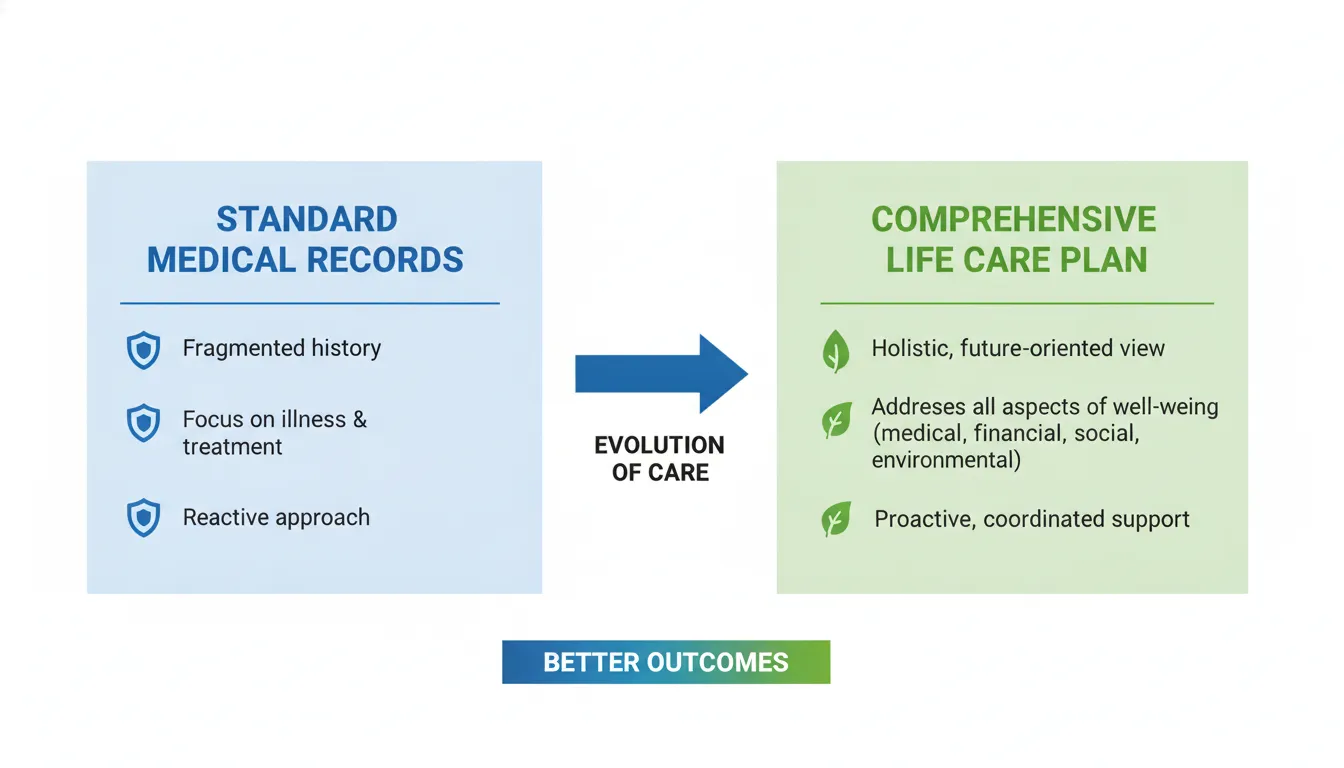
Comparison between standard medical records and a comprehensive life care plan
Comparing standard medical records with a comprehensive life care plan helps illustrate why standard documentation often falls short of capturing lifetime costs.

Michigan’s auto no-fault law has seen changes that make life care planning even more important. After July 1, 2020, people injured in auto accidents may face limits on benefits. This makes it crucial to accurately assess future needs and secure proper compensation to avoid financial hardship. You can read more about how no-fault reform affects those with catastrophic injuries in Michigan to understand your rights. The Michigan Department of Insurance and Financial Services provides details on these changes.

A life care plan provides a clear, documented path for long-term care. It is an essential tool for ensuring that individuals with catastrophic injuries receive the support they need. Understanding the nuances of these plans can help families navigate the complex challenges ahead.

Key Components of a Comprehensive Life Care Plan

A life care plan is a detailed document that outlines the medical and non-medical needs of an individual who has sustained a catastrophic injury or chronic illness. These plans help families and legal teams understand the financial impact and care requirements over a lifetime.

Developing a comprehensive plan ensures that all aspects of a person’s well-being are addressed, from immediate treatment to long-term support. It serves as a roadmap for ongoing care.

Understanding the Elements of a Life Care Plan

A life care plan for catastrophic injury is specific to each individual. It covers many areas of support and care. These include medical care, equipment needs, and home adjustments.

The plan looks at all future needs. These include doctor visits, therapy, and psychological support. The goal is to improve the injured person’s quality of life as much as possible.

  1. Physical Therapy and Rehabilitation: Physical therapy helps restore movement, strength, and function after an injury. It is often a key part of recovery, helping patients regain independence. Participating in structured physical and cognitive therapy after an accident is vital for long-term health.

  2. Home Modifications: Changes to the home environment can greatly improve safety and accessibility. These might include ramps, widened doorways, or accessible bathrooms. Home modifications help individuals live more comfortably and independently.

  3. Medication Management: Managing medications is vital for health and pain control. A life care plan details all necessary prescriptions, dosages, and administration schedules. It ensures that medication needs are met consistently.

  4. Surgeries and Medical Procedures: Future surgical needs are often projected in the plan. This includes procedures to address new complications or improve existing conditions. The plan considers both planned and potential future medical interventions.

  5. Psychological Counseling: Catastrophic injuries often bring emotional and mental health challenges. Counseling provides support for coping with trauma, depression, and anxiety. Mental health care is a critical part of a holistic recovery process.

  6. Occupational Therapy and Adaptive Equipment: Occupational therapy helps individuals adapt to daily tasks and improve their ability to perform activities of daily living. This may involve training in new techniques or using adaptive equipment. Examples include wheelchairs or communication devices. According to the U.S. Bureau of Labor Statistics, occupational therapists help people participate in the things they want and need to do through the therapeutic use of everyday activities.

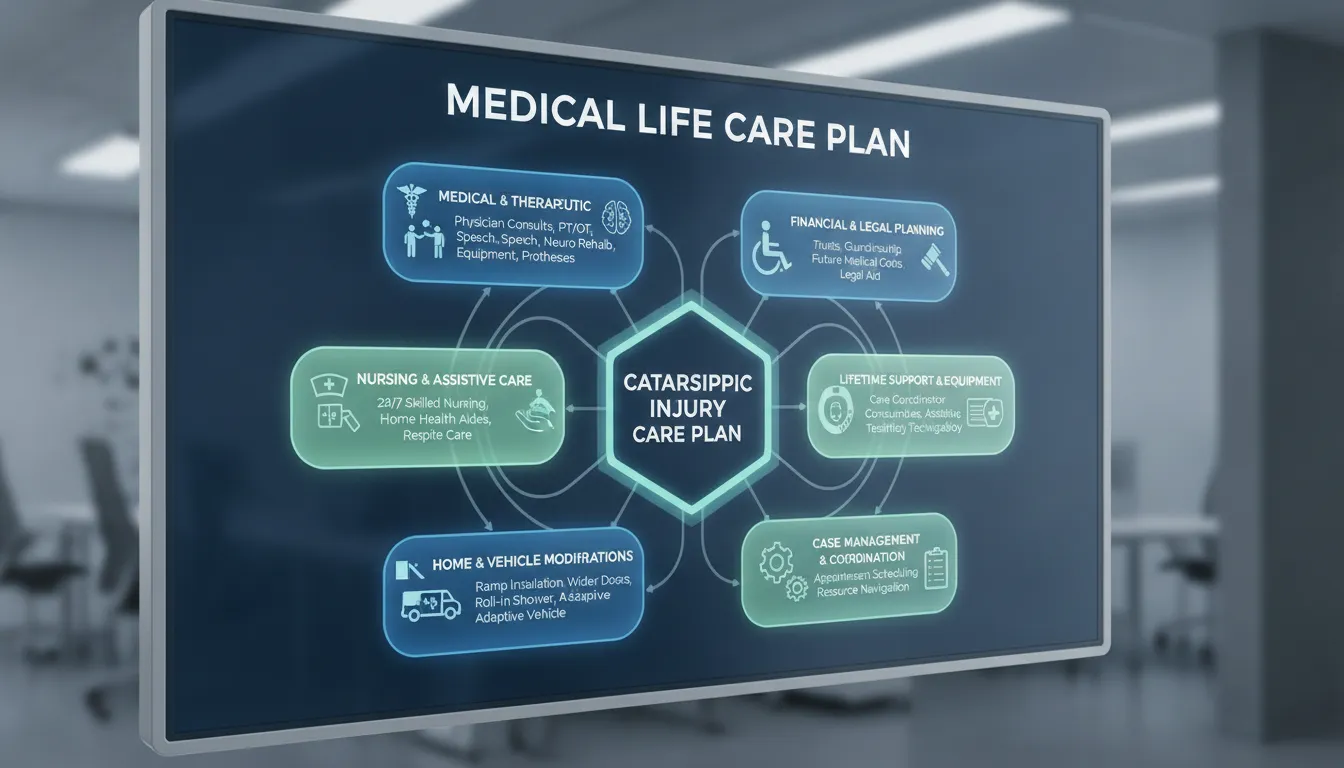
Diagram showing the core components of a comprehensive medical life care plan
A comprehensive life care plan maps out diverse components, from physical rehabilitation to environmental modifications, for a holistically structured recovery.

Each component plays a role in supporting the long-term well-being of the injured person. The plan is a living document. It can change as needs evolve over time.

Who Qualifies as a Certified Life Care Planner?

A certified life care planner (CLCP) is a highly trained professional who creates comprehensive plans for individuals with catastrophic injuries or chronic health conditions. These plans detail current and future medical, rehabilitation, and personal care needs. They also estimate the costs associated with these needs over a person’s lifespan. CLCPs help individuals and families navigate complex care requirements.

Professional Backgrounds

Many CLCPs come from healthcare fields. This includes registered nurses (RNs), occupational therapists (OTs), and physical therapists (PTs). Other medical professionals also pursue this certification. Their clinical experience provides a strong foundation for understanding complex medical situations and long-term care needs. This background helps them evaluate treatment options and anticipate future challenges.

Specialized Training and Certification

Becoming a CLCP requires rigorous specialized training. Candidates must complete a 120-hour program focusing on life care planning principles and methods. This training covers areas like medical case management, legal aspects of life care planning, and research methodologies. After completing the training, candidates must pass a certification exam to earn the CLCP designation. This ensures they meet high professional standards.

The International Commission on Health Care Certification (ICHCC) offers the CLCP certification. This credential signifies that a planner has met strict educational and experiential criteria. It shows a commitment to ethical practice and ongoing professional development. CLCPs must also maintain their certification through continuing education to stay current with best practices.

Why Certification Matters

Certification ensures a life care planner has the specific knowledge and skills needed for this work. It helps guarantee the reliability and accuracy of the life care plans they create. For legal cases involving catastrophic injuries, the CLCP credential is often critical. It provides credibility and expertise when presenting future care needs and costs in court. This professional standard helps clients receive fair and accurate assessments of their long-term care requirements.

How a Life Care Plan Affects Your Catastrophic Injury Settlement

Understanding Catastrophic Injury Damages

Catastrophic injuries are life-altering events, often leading to permanent disability. These injuries demand extensive medical care, rehabilitation, and support services. The financial impact can be overwhelming, extending far beyond initial hospital stays. Victims may face ongoing costs for specialized equipment, home modifications, and professional care for decades.

Determining the true value of these long-term damages is complex. It requires looking at future medical needs, lost earning capacity, and the impact on daily life. Without a clear plan, victims risk receiving settlements that don’t cover their full lifetime expenses. Families seeking compensation after a life-altering event in Western Michigan should consult experienced advocates about catastrophic injury claims in Kalamazoo to ensure all future needs are fully protected.

What a Life Care Plan Offers

A life care plan is a comprehensive document that details all current and future medical and non-medical needs for a catastrophically injured person. This plan is developed by a certified life care planner, often a registered nurse or other healthcare professional with specialized training. It provides a roadmap of anticipated care, services, and equipment, all backed by medical standards and cost data.

The plan projects expenses for everything from doctor visits and medications to home health aides, adaptive equipment, and vocational retraining. It helps to ensure that no future need is overlooked. Medicare Secondary Payer (MSP) requirements, for instance, often necessitate detailed projections for future medical care to protect Medicare’s interests.

Preventing Under-Reserving and Poor Settlements

In personal injury litigation, a life care plan is a crucial tool. It provides a credible, evidence-based assessment of lifetime damages. This helps insurance adjusters understand the full scope of financial responsibility, preventing under-reserving, which is when insurers set aside too little money for a claim. For juries, the plan translates complex medical jargon and future needs into understandable financial terms, making it easier to award fair compensation.

The detailed breakdown from a life care plan also guides the creation of structured settlements. These settlements involve periodic payments rather than a lump sum. A well-designed structured settlement, informed by a life care plan. Can ensure that funds are available for specific needs as they arise throughout the victim’s life, providing financial security and peace of mind.

Frequently Asked Questions

What is a life-care plan for catastrophic injuries in Michigan?

A life-care plan is a detailed document outlining the long-term medical, rehabilitation, and personal care needs for someone with a catastrophic injury. It projects future expenses for therapies, equipment, home modifications, and assistive services. This plan serves as a crucial tool for legal settlements and ensuring the injured individual receives necessary support throughout their life in Michigan.

Who creates a life-care plan in a Michigan injury case?

Certified life-care planners, often healthcare professionals with specialized training, create these plans. They assess the injured person’s specific needs, consult with medical experts, and project future costs based on medical records and anticipated care requirements. Their expertise ensures the plan is comprehensive, credible, and defensible in Michigan legal proceedings, providing an accurate forecast of future expenses.

Can a life-care plan be updated after it’s created?

Yes, life-care plans can and often need to be updated. As an individual’s condition evolves, or new treatments become available, the plan may require revisions. These updates ensure the plan remains accurate and reflective of the current and future needs of the person with the catastrophic injury. Changes in medical status or care requirements necessitate periodic review and adjustment, especially in long-term cases.

How does a life-care plan support a personal injury lawsuit?

It translates complex long-term medical needs into concrete, defensible financial figures. This helps lawyers, insurers, and juries understand exactly what is required to support the injured person. Preventing lowball settlement offers and ensuring that the final award is sufficient to cover lifelong care expenses.

What types of injuries require a life-care plan in Michigan?

Typically, any catastrophic injury resulting in long-term or permanent disability. This includes traumatic brain injuries (TBIs), spinal cord injuries, severe amputations, birth injuries, and third-degree burns. Any injury that requires ongoing medical treatment or in-home daily assistance benefits from a life-care plan.

Is the cost of creating a life-care plan worth it?

Yes, absolutely. While hiring a certified life-care planner involves an upfront cost, the resulting plan often uncovers millions of dollars in future expenses that would otherwise be missed. Ensuring the victim does not run out of funds and protecting their long-term quality of life.

Ready to Schedule Your Free Consultation?

Delay in seeking legal counsel after a catastrophic injury can complicate your case and impact your ability to secure deserved compensation. At Atnip & Associates, PLLC, we act quickly to protect your rights, collect vital medical assessments, and build a comprehensive life-care plan to support your financial recovery. Every day counts when building a strong catastrophic injury claim in Michigan.

Contact our experienced Michigan personal injury lawyers today. Schedule a free consultation online or call us directly at 248-599-1607. Remember, there is no fee unless we win your case.

ARCHIVES

RECENT POSTS