

A collision with a tractor-trailer, semi, delivery truck, or another large commercial vehicle can leave a family facing serious injuries and difficult questions. The driver may not be the only person or business involved. Trucking records, multiple insurance policies, vehicle data, and long-term medical needs can all affect what happens next.
A lawyer for big truck accident injuries can help investigate the crash, preserve evidence. Identify potentially responsible parties, review available insurance coverage, and evaluate damages tied to the injury. In Michigan, the right legal path depends on the facts, the policies involved, and the nature of the injuries. This guide explains the issues to consider before deciding whether to seek counsel.
If you are still receiving treatment, dealing with an insurer, or trying to understand how your family will manage after a serious crash. Start by protecting your health and preserving information about what happened. The differences between a truck claim and an ordinary car claim often begin at the investigation stage.
Call 248-599-1607 to schedule a free consultation
Why are big-truck crash claims different from car-accident claims?
A commercial truck crash can involve more than the impact between two vehicles. The truck’s size and weight may contribute to severe consequences. Its operation can involve a driver, a motor carrier, maintenance providers, cargo interests, and more than one insurer. That does not mean every truck crash creates the same claim. It means the investigation may need to examine more than a typical passenger-car collision.
| Issue | Why it may matter |
|---|---|
| Vehicle and operation | A commercial vehicle can involve carrier records, equipment information, and operational questions beyond a typical car claim. |
| Driver hours | Hours-of-service records may be relevant when fatigue or scheduling is part of the factual investigation. |
| Insurance | More than one policy or insurer may evaluate the same crash from different perspectives. |
| Injury impact | The size and weight of a truck can contribute to severe injuries that require a long-term damages review. |
Federal motor-carrier rules can also add another layer of questions. The Federal Motor Carrier Safety Administration explains that hours-of-service rules address the maximum time a commercial driver may remain on duty. The rules include driving time and specify rest periods intended to help drivers stay awake and alert. In general, carriers and drivers operating commercial motor vehicles must comply with the hours-of-service regulations in 49 CFR 395. These rules do not, by themselves, prove that a driver or company caused a particular crash. They can make operational records relevant when fatigue or scheduling is part of the factual investigation.
The evidence can therefore include records that are not usually central to a basic car claim. Depending on the facts, counsel may seek driver and carrier records, vehicle information, inspection or maintenance material, dispatch information, and communications. A truck accident investigation should be focused, timely, and tied to the actual issues in dispute.
For a comparison point, see Atnip’s Michigan car-accident claims resource. The firm’s Michigan truck accident attorneys page provides a separate path for people seeking representation. This article remains an educational overview, not a determination of liability in any individual case.
What evidence can matter after a commercial truck crash?
Evidence can disappear, become harder to interpret, or be viewed differently as an insurance claim develops. Begin with the information you can safely preserve. Keep photographs and videos of the vehicles, roadway, signs, visible injuries, and surrounding conditions. Save contact information for witnesses, the crash report, medical records, bills, work records, and communications from insurers. Do not delay necessary medical care while trying to assemble a perfect file.
Commercial truck cases may require a broader scene investigation than a routine collision. The available evidence may include crash debris, traffic-camera footage, security footage, eyewitness statements, and information used in crash reconstruction. NHTSA’s Large Truck Crash Causation Study describes a database of 1,000 serious large-truck crashes with more than 1,000 data elements per crash. The study also discusses the value of collecting information at the scene immediately after a crash.
Those observations support the practical importance of timely preservation, but they do not decide the cause of your collision. As a practical starting point, you can:
- Seek appropriate medical care and follow the treatment plan.
- Photograph the vehicles, roadway, visible injuries, and surrounding conditions when it is safe.
- Save witness details, reports, medical records, bills, and insurer communications.
- Avoid signing a release or giving a recorded statement before understanding the request.
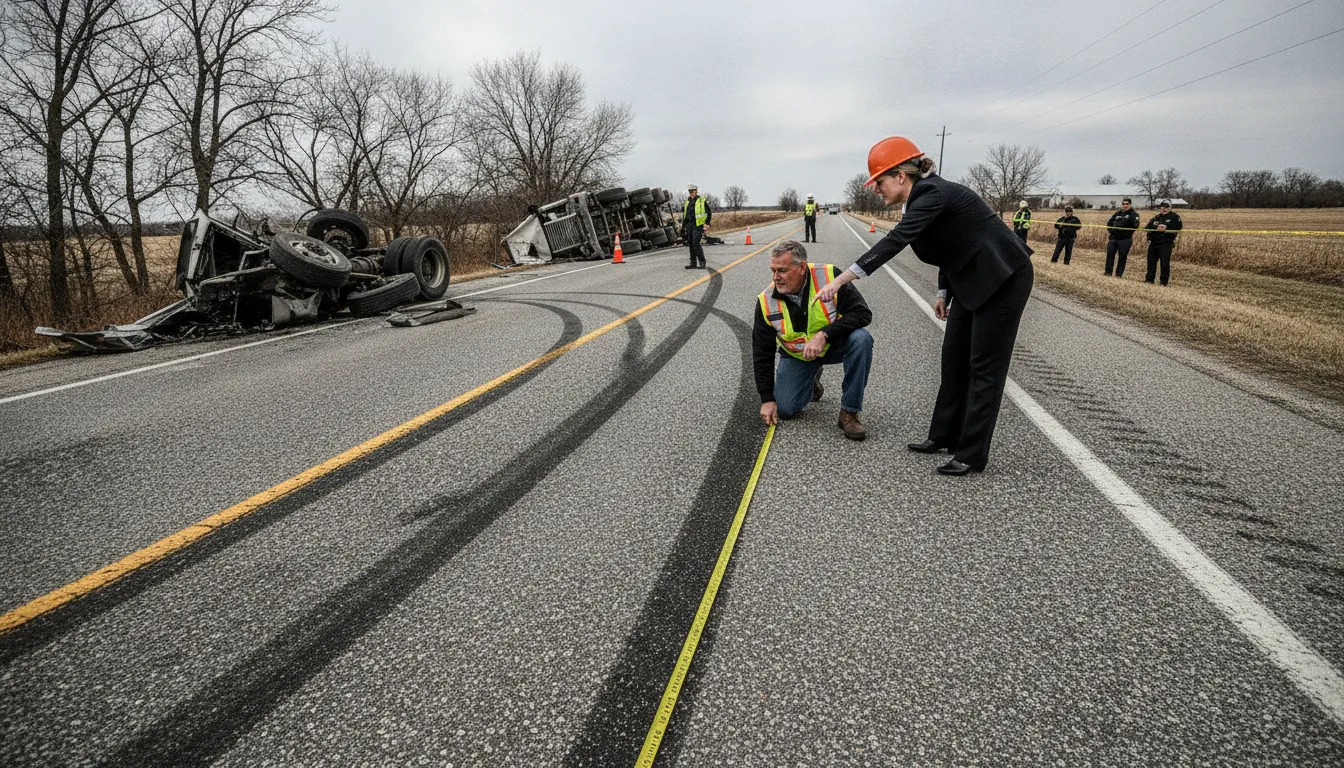
Some evidence is especially vulnerable to loss or alteration. Driver logs, electronic records, and vehicle-system data may require prompt preservation requests and careful interpretation. Learn more about evidence after a truck accident, truck driver logs and electronic records, and truck black-box data. These narrower resources address specific evidence topics without replacing a case-specific review.
An attorney may also compare the police report with photographs, medical records, witness accounts, and physical evidence. Atnip describes independent investigation as including accident reconstruction, medical-record analysis, witness interviews, and coordination with appropriate experts. The purpose is to develop a reliable account of the collision and its effects, not to assume that an early report answers every question.
Who may be responsible for a Michigan truck accident?
Responsibility depends on what caused the crash and who had a legal duty related to that cause. The truck driver may be a focus of the investigation, but a claim may also require examining the motor carrier. A maintenance provider, a cargo or loading operation, or another involved party. Those possibilities are not conclusions. They are questions that must be tested against records, witness accounts, physical evidence, and applicable Michigan law.
A commercial carrier may have responsibilities connected to the driver’s work, vehicle upkeep, scheduling, supervision, or safety practices. Maintenance or loading issues may also matter if evidence shows that they contributed to the collision or worsened the injuries. A driver may dispute the account, and a company or insurer may present a different explanation. The investigation should identify each theory that the evidence supports rather than naming every possible party automatically.
Truck claims commonly require proof of injury or damages, proof of negligence, and a reasoned determination of responsibility. In a Michigan third-party claim, the nature of the injury can also matter. Serious impairment of body function or permanent disfigurement may be relevant legal issues, depending on the facts and the claim being pursued. A lawyer can explain which elements apply after reviewing the crash and medical information.
If a truck was being used for work, the relationship between the driver and company may also require attention. A related resource explains company-vehicle accident guidance, including issues that may arise when a work vehicle is involved. A serious truck crash can raise more than one liability theory, but the available evidence must support each one.
How do Michigan no-fault and liability insurance claims interact?
Insurance after a Michigan truck crash can involve more than one claim. A first-party claim generally concerns benefits under the injured person’s own auto policy or another applicable policy. A third-party claim generally seeks damages from a person or business alleged to have caused the crash. The claims can involve different legal questions, different insurers, and different evidence. One claim does not automatically resolve the other.
Michigan no-fault personal protection insurance, commonly called PIP, may involve reasonable and necessary medical expenses, wage loss subject to legal and policy limits, replacement services, and attendant care. Available benefits and policy choices can differ. The applicable policy, the date and circumstances of the crash, coordination with other coverage, and the person’s medical and work records all matter. Avoid assuming that a general description of PIP predicts what an insurer must pay in your case.
A serious injury may also lead to a liability claim against an at-fault driver or other responsible party. Depending on the facts, that claim can involve proving negligence, responsibility, a legally significant injury, and damages. The available insurance may include the injured person’s coverage and commercial policies connected with the truck or business. Multiple carriers may evaluate the same event from different perspectives.
Atnip’s Michigan no-fault insurance benefits resource provides more background on first-party and third-party issues. An attorney can help organize notices, medical documentation, wage information, and insurer communications. Because insurance rights and deadlines are fact-specific, seek advice promptly rather than relying on a general article to make a filing decision.
What damages may follow a serious truck crash?
The effect of a large-truck collision may continue long after emergency treatment. Some people face a traumatic brain injury, spinal cord damage or paralysis, severe burns, amputation, permanent disfigurement, or another life-changing condition. Others may experience less visible cognitive, emotional, or physical limitations that affect work and daily activities. Medical evaluation and an honest record of changes over time are important.
Potential damage categories can include past and future medical expenses, lost wages, diminished earning potential. Pain and suffering in a serious-injury case, lost quality of life, and property damage. A claim does not automatically include every category, and the amount or availability of damages cannot be predicted from the fact of a crash alone. Medical records, work history, expert analysis, and the applicable law may all affect the evaluation.
Future needs deserve careful attention when an injury is catastrophic. A family may need ongoing treatment, rehabilitation, assistive equipment, home modifications, attendant care, or changes in living arrangements. A medical or financial expert may help explain those needs, but an expert opinion must be based on the person’s actual condition and likely future circumstances. Do not minimize an injury simply because its full effect is not clear in the first days after a collision.
Atnip’s catastrophic injury claims resource discusses serious injuries and the broader needs that can follow them. If a crash caused cognitive effects, the firm’s information on brain injuries after a truck crash may also be relevant. These resources are not a promise of compensation. They are starting points for understanding why a full damages review may be necessary.
When should you speak with a lawyer for big truck accident injuries?
Consider speaking with counsel promptly when the crash involved a commercial vehicle, serious injury. Disputed responsibility, a fatality, multiple insurers, or a possible long-term change in health or work. Early advice can help protect evidence before records are lost and can give a family a clearer way to organize medical, employment, and insurance information. It does not mean that a lawsuit must be filed or that an outcome can be predicted.
A consultation may be useful if an insurer asks for a recorded statement, offers a release. Questions the need for treatment, delays benefits, or suggests that another person is responsible. Read communications carefully and avoid guessing about facts you do not know. Do not sign a settlement or release before understanding what rights it may affect. A lawyer can explain options after learning the facts and reviewing the available documents.
When evaluating representation, ask who will communicate with you, how the investigation will be handled, what information the firm needs, and how fees and case costs work. Atnip & Associates emphasizes direct attorney consultation, regular updates, independent evidence development, and assistance understanding insurance benefits and recovery needs. The firm also has attorneys with insurance-defense backgrounds, which can inform their understanding of insurer evaluation processes and anticipated defense arguments. That experience is not a guarantee of a particular result.
Atnip represents people and families injured by negligence throughout Michigan, with offices in Rochester Hills and Escanaba. The firm’s truck-accident practice is one place to learn more about Michigan truck accident attorneys. The firm describes its fee arrangement as no upfront legal fees and no fee unless it wins, subject to the written agreement and case-specific terms.
Call 248-599-1607 to schedule a free consultation
Frequently Asked Questions
When should I hire a truck accident lawyer?
Consider a consultation as soon as practical after a commercial truck crash, particularly when there is a serious injury. Disputed fault, a fatality, multiple insurers, or evidence that may be difficult to preserve. A consultation does not commit you to filing a lawsuit. It can help you understand what information to protect and what questions to ask before responding to an insurer.
Can I afford a truck accident lawyer?
Many personal injury firms, including Atnip & Associates, handle qualifying matters through a contingency fee arrangement. The firm describes this as no upfront legal fees and no fee unless it wins, subject to the written agreement and case-specific terms. Ask how fees, litigation expenses, and other costs are handled before signing an agreement.
How long does a truck accident lawsuit take?
There is no reliable universal timeline. The duration can depend on the severity of the injuries, treatment progress, evidence collection. The number of parties and insurers, the issues in dispute, and whether the matter resolves through negotiation or requires litigation. A lawyer can discuss likely stages after reviewing the facts, but should not promise a particular schedule.
How much are most truck accident settlements?
Settlement values vary widely and cannot be responsibly predicted from a general average. The nature and duration of the injuries, medical needs, lost income, evidence of responsibility, available insurance, and other legal and factual issues can affect a claim. Be cautious of anyone promising a specific recovery before investigating your case.
Talk With a Michigan Truck Accident Attorney
A commercial truck crash can leave you managing treatment, work disruption, insurance questions, and uncertainty about what comes next. You do not have to sort through those issues without information. Atnip & Associates, PLLC provides personalized personal injury guidance to individuals and families throughout Michigan, including people dealing with serious and catastrophic injuries.
For others, it’s just another case. For us, it’s personal. To discuss your situation and learn whether a consultation may help, schedule a free consultation or Call 248-599-1607 to schedule a free consultation. No fee unless we win, subject to the written fee agreement and your specific matter.
